Impact Story
Snapshot from 2025: Niger
How reliable data is opening new doors for investment
When the Ministry of Public Health and Hygiene established a Technical Working Group around our WASH FIT evaluation tool in 2020, no one knew where it would lead. But over time, we’ve developed trust, a shared vision, and a decision by government to make WASH FIT the common entry point for all water and sanitation work in healthcare facilities.
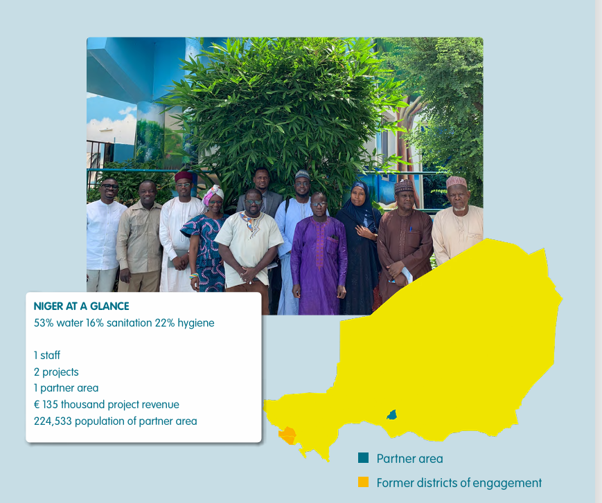
This year, alongside the Ministry, we rolled out WASH FIT 2.0 in the Dosso region, training health and water and sanitation officials who would go on to train others. We also documented WASH FIT experiences across the Sahel (Burkina Faso, Mali, and Niger) in a learning note.
But what’s truly changed is that for the first time, we now know precisely who funds the sector, by how much, and where the gaps are, using WHO’s TrackFin methodology. We worked with the Ministry, WHO, WaterAid, World Vision, and UNICEF, to develop an SDG 6 roadmap for healthcare facilities and we’re now preparing a national roundtable to plan how we’ll finance it.
Getting partners on board has taken time. Collecting data was another obstacle: CSOs are not always used to sharing financial information. And staff leaving means the loss of knowledge and relationships. This reminded us why it matters so much to anchor processes within systems, not individuals.
“What we’re building in Niger is a culture where decisions are made on facts, not assumptions. That’s the real lever for change.”
Ismaël Ousmane, Riva Sahel - Niger