Impact Story
Snapshot from 2025: Burkina Faso
When data becomes a tool for governance and accountability
In Burkina Faso, rural piped water systems are operated under lease arrangements (‘affermage’) where private operators manage infrastructure on behalf of municipalities.
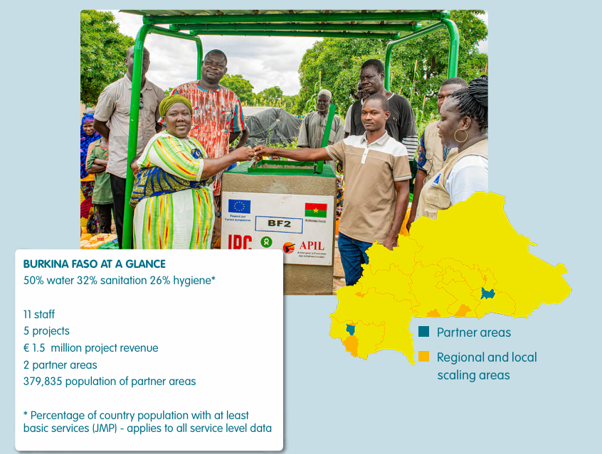
For years, tracking the performance of these systems meant chasing paper registers across communes and waiting months for data that was outdated by the time decisions were made. The contracts and reporting obligations were in place. What wasn’t, was a shared, reliable picture of how systems were actually performing.
Together with ONEA and the General Directorate of Drinking Water, we helped roll out a digital platform to track key performance indicators across leased water systems. We trained and supported operators in seven regions (Centre, Centre Ouest, Centre Est, Centre Sud, Boucle du Mouhoun, Plateau Central, Cascades) to regularly input technical and financial data: water volumes produced and sold, revenues collected, breakdowns, maintenance interventions.
For the first time, performance data from 168 water systems (of the 195 water systems under affermage across the programme’s seven regions) was consolidated in one place, and visible to all operators, municipalities, state technical services and other stakeholders. This has improved transparency, ensured everyone was working from the same information, and strengthened the ability of public authorities to monitor service delivery and enforce contractual obligations.
The real breakthrough came when that data stopped being a reporting exercise and became a governance tool. Regional performance review workshops brought more than sixty stakeholders together per region (operators, municipalities, technical services, regional governors) to interrogate the reports. They asked questions like, ‘Why do breakdowns persist?’, ‘Why are revenues insufficient to cover maintenance?’, ‘Why are contracts not enforced?’. These weren’t comfortable conversations, but they led to concrete decisions. Ten critically underperforming systems have already been prioritised and developed into ready-to-finance investment projects, targeting real needs instead of assumptions.
There have been challenges. Institutional reforms – like reorganising the Ministry of Water - slowed engagement at national level. Data quality varied. Supporting operators to report consistently required time, coaching and repeated presence in the field.
“Despite the efforts made, sustainable access to safe drinking water remains a challenge. This requires us to improve the management of our infrastructure and strengthen our collective responsibility to ensure reliable services for communities.”
Adama Jean Yves Bere, Governor of the Centre-Ouest Region