Change Story
A key response to climate change: local ownership
Climate resilience starts with local ownership: Bangladesh communities creating lasting water and sanitation solutions

The bigger picture
In Bangladesh, one of Riva’s focus areas is the Haor region in the northeast. These are vast wetlands where, for almost half of the year, seasonal flooding turns villages into islands. For a family in the Haor, the arrival of floodwaters changes almost every aspect of daily life. Children travel to school by boat, access to healthcare becomes more difficult, and sanitation facilities that took time and money to build can be submerged or damaged within weeks. Climate change is making these disruptions more frequent and less predictable. Imagine building a toilet and then watching it disappear under floodwaters a few months later. For many families, this means that sanitation gains are repeatedly lost, and communities can be pushed back towards open defecation.
How we worked
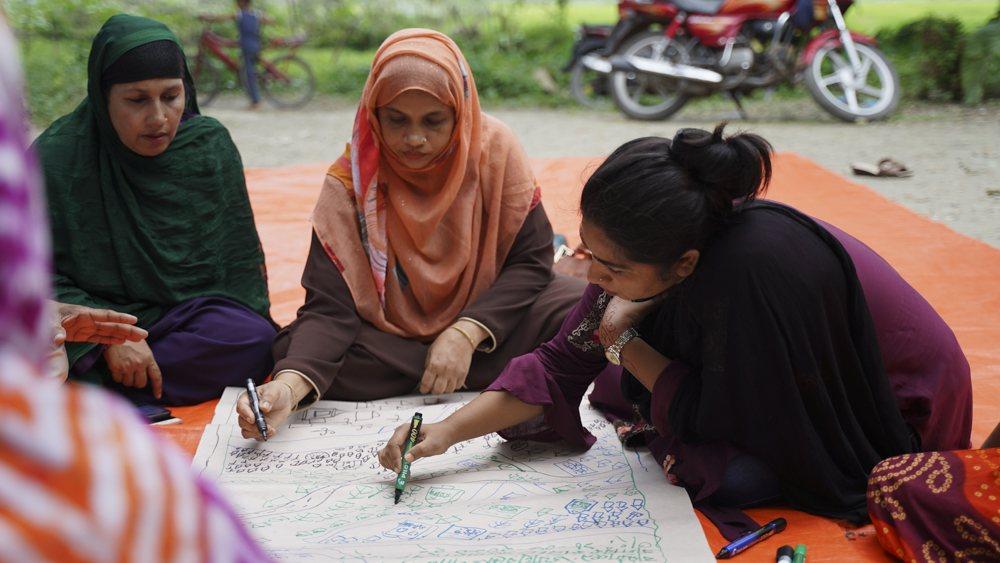
Together with BRAC, we worked alongside communities in the Haor. BRAC's field teams led by Farukh Hossain helped families organise, identify local solutions and support entrepreneurs, while Digbijoy Dey together with other Riva specialists worked with local partners to develop practical, flood-resilient sanitation options. Together, we produced practical manuals for climate-resilient sanitation and adapted community mobilisation tools into Bengali so that others could apply the same approaches.
On the coast, in the small town of Patharghata, that same partnership backed Shiuli Begum — a mother of two who, three years ago, had never run a business. For most of her life, she'd made impossible choices just to keep her family healthy. "We used to drink water from the pond," she says. "It wasn't salty like the river, but it was never clean." Rainwater never lasted the season, and the cost showed up in illness and medicine bills for her family and their community of around 1,000 people.
Everything changed when she met Shamsul, a local BRAC project officer, who told her people in other sub-districts had set up their own water treatment plants with support from the partnership. It was a big leap – hers would be the first plant of its kind in the sub-district – but her husband, a boat repairer with a habit of chasing new technology, encouraged her to take it. With a loan and technical advice, she did.
She gave the water away free at first. "We'd almost forgotten the taste of clean water," she says of her neighbours' reaction. Gradually, people started paying, and BRAC's own sub-district office became her first corporate client. This year, her plant tripled its capacity.
What changed
Rather than building infrastructure, we’re helping communities and local partners to develop systems that can withstand a changing climate. Bangladesh may face some of the world's toughest climate-related water challenges, but it is also becoming a place where new ideas for climate-resilient water and sanitation solutions are emerging.