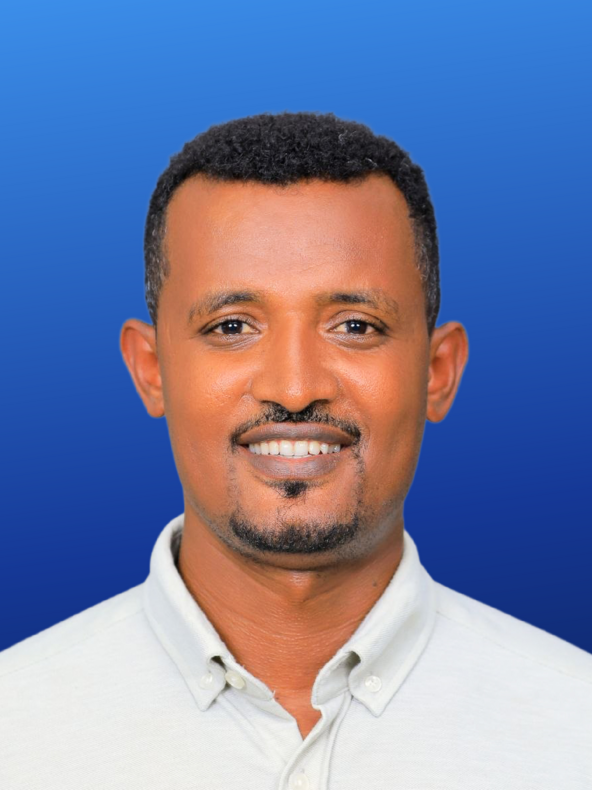
Working in the Abbay Basin taught me that water problems are rarely just about water. What looks like a resource challenge is often a question of governance, incentives, investment and leadership. Water is the connector. Data reveals the connections. Follow the water and you begin to understand the system. Follow the evidence and you begin to understand where change is possible.
Girmachew Addisu
For nearly two decades, Girmachew Addisu has explored a question that continues to shape his work: why do some systems adapt and improve while others struggle to respond to increasingly complex challenges? His career began at Woldia University before moving to the Abbay Basin Authority, where he spent five years studying water resources across the Upper Blue Nile. There, the challenges appeared technical: declining water quality, growing competition between users, and increasing pressure on finite resources. Yet the deeper he looked, the clearer it became that the real drivers often lay elsewhere, in institutions, incentives, leadership and the choices people make.
Since joining IRC Ethiopia, now Riva, in 2019, Girmachew's perspective has expanded from seeing water as a resource to seeing it as a lens through which to understand how entire systems function. He works with governments, utilities, researchers and development partners to strengthen governance, investment planning, monitoring and learning, and climate resilience. His focus is not simply on generating evidence, but on helping leaders use evidence to make better decisions, align priorities and build systems that continue to learn and improve long after external support has ended.
What sets Girmachew apart is his ability to bridge science, policy and implementation. He has worked as an academic, a government specialist, an international research coordinator and a systems adviser. Through partnerships such as the Blue Deal programme with World Waternet and the National Science Foundation-funded Partnerships for International Research and Education (PIRE) collaboration with the University of Connecticut, he has seen how evidence, relationships and institutions interact to create change. This inside-out perspective enables him to translate complexity into clarity and help leaders see not only where problems exist, but where opportunities for transformation can be unlocked.
Girmachew holds an MSc in Civil and Water Resources Engineering, specialising in Hydraulics Engineering and Water Resources Management, from Bahir Dar University, and a BSc in Soil and Water Engineering from Haramaya University.
A few highlights
- 18+ years of experience spanning academia, government and international development, including seven years at Woldia University, five years at the Abbay Basin Authority, and since 2019 with Riva (formerly IRC)
- Monitoring and Learning Advisor at Riva, supporting governments and partners to strengthen decision-making, accountability and long-term system performance.
- Resident Project Leader for the Blue Deal partnership between the Abbay Basin Authority and World Waternet, strengthening water governance and institutional collaboration.
- Coordinator of the NSF-funded PIRE programme, linking the Abbay Basin Authority and the University of Connecticut to advance research and decision-making in the Upper Blue Nile Basin.
- Led the development of monitoring, learning and information systems that strengthen planning, performance tracking and investment decisions across regional governments and utilities.
- Published research on water security, climate resilience, groundwater management and forecast-informed water allocation in the Blue Nile Basin.
- Working languages: fluent in Amharic and English