Article
The world in flux: Exploring the future of water and sanitation
Reflections from the WASH Debate of 10 July 2025
Our latest WASH Debate, In flux: Trends in water and sanitation and what they mean for Dutch development cooperation, explored the future of water and sanitation services and water management in general. This futures exploration was informed by an analysis of global trends both within and beyond the water sector, and by the identification of possible scenarios. This analysis formed the basis for a debate with four experts working in (Dutch) international development cooperation in the field of water.
Mapping the future: trends and scenarios for the water sector up to 2040
The WASH debate kicked off with a key-note presentation by Independent Researcher and former IRC Associate, Dr. Angela Huston Gold. In her keynote, she highlighted how the water sector is affected by a complex set of trends in climate change, shifting geopolitical dynamics, and a changing landscape for international development cooperation.
Within each of these broad categories, she identified key global and institutional trends that interact to shape water sector outcomes. These trends are then categorised according to the extent to which they are certain or uncertain, and their relative importance for WASH and water management.
Three particularly uncertain but important factors emerged: changes in geopolitical relations, the extent to which domestic resource mobilisation will happen for water in lower middle-income countries (LIMC), and the prioritisation of resilient, safely managed services.
Based on these, Angela identified four possible scenarios for how the sector may evolve:
- Scenario 1 (worst case): Every country goes its own way – Marked by high levels of geopolitical instability combined with economic crisis and low demand or prioritisation of improving water and sanitation services
- Scenario 2 (best case): New stability in a multi-polar world – Peace and diplomacy combined with high levels of demand for climate resilience and safe services lead to increased public investment in water and sanitation.
- Scenario 3 (middle ground): Private initiatives in absence of accountable public service provision – Economic crisis and geopolitical instability hinder public investment, however citizen demand for improving services remains high, leading to significant private investment.
- Scenario 4 (middle ground): The next chapter of aid: climate finance – Despite global conflicts, LMIC governments leverage climate finance and regional/national development funds for water investments, however many facilities are rudimentary.
In response to these scenarios, she ended her presentation with a call to Dutch water sector actors to adopt flexible strategies that can work across scenarios, with roles ranging from humanitarian aid in fragile contexts to providing expertise in climate finance and resilience.
New challenges, new roles: Reflections from the panel discussion
Following the keynote presentation, a panel discussion was held to explore how to adapt to these fluctuating trends and improve the trajectory towards more promising outcomes. In addition to presenter Angela, the panel also included:
- Bethlehem Mengistu, Global Coordinator of Agenda for Change
- Maarten Gischler, Senior Water Advisor at the Dutch Ministry of Foreign Affairs
- Joep Verhagen, Global Lead Water and Urban at the Global Center on Adaptation
- Patrick Moriarty, CEO of IRC
The core strategic directions that emerged during the debate include the following:
1. A growing need for specialisation
Affordable capital is becoming scarcer for low-income countries, which raises concerns particularly for the world’s poorest. Maarten Gischler indicated that Official Development Assistance (ODA) is under pressure, while accessing private capital for water investments remains challenging due to high return expectations. The shift away from ODA is not only reflecting a negative situation. Some countries are indeed transitioning away from being aid recipients to being middle-income countries, and there is a need to celebrate successes and avoid over-reliance on the "poorest of the poor" narrative. At the same time, the sudden cuts in aid, as we have seen over the past half year, do not give all countries sufficient time to adjust.
For bilateral donors, one of the strategies is to specialise in a few thematic areas. In the case of the Netherlands, this includes water, as Maarten Gischler pointed out. But other bilateral donors may focus on other topics. This specialisation by donors in turn requires a stronger coordination by recipient countries to address the various pieces of the puzzle. Specialisation alone is not enough to solve the complex issues of water management in the face of climate change.
NGOs may also need to specialise, as was evident from the contributions from panellists on the shifting role of NGOs in light of the changing aid landscape. Bethlehem Mengistu explained that as countries transition to middle-income status, NGOs will need to specialise in areas such as technical assistance and system support, become smaller and more agile, while leveraging strategic partnerships. She noted that private sector consultancies are increasingly being favoured by governments for development work, prompting NGOs to consider their niche roles and how to collaborate without duplication.
The conversation also addressed the challenges of shrinking civic space and the importance of maintaining a respectful and inclusive dialogue in the face of shrinking civic space and political challenges.
2. Resilience against climate change, an imperative
Panel members addressed the challenges posed by climate change and the uncertainty of adaptation of the water sector to these new realities.
The discussion focused on the challenges and opportunities in climate adaptation and finance, particularly in Africa. This entails amongst others investing in infrastructure and urban planning to address climate change impacts. They noted that while climate finance is growing, it is still inadequate to meet the needs for resilience and risk mitigation. Even though there are good examples, many of the poorest countries are not in a financial position to adapt.
3. A strong public system for domestic resource mobilisation
The central importance of domestic resource mobilisation was emphasised. There are countries where this is likely to happen. Domestic resources can be mobilised through commercial financing, corporate social responsibility initiatives and the public sector itself. Participants discussed the limitations of corporate social responsibility and private investments – both of which require stronger public sector systems. The strong public system includes regulation of service providers in order to reduce financial risks and thus the interest rates paid by borrowers.
Yet, particularly among the world’s poorest countries, there are unsurmountable financial limitations to securing high levels of services that need to be acknowledged and addressed, according to Patrick Moriarty.
Scenario-based planning to define strategies in the face of uncertainty
The world is undoubtedly experiencing a period of substantial geopolitical shifts and changing landscape of international aid. Scenario planning is not about predicting the future, but about preparing for a range of diverse possibilities. Success lies in developing strategies that can be effective across multiple scenarios - demonstrating flexibility and adaptability in the face of uncertainty, but also in fostering collective discussions and reflections on how we can shape a more resilient and fair future.
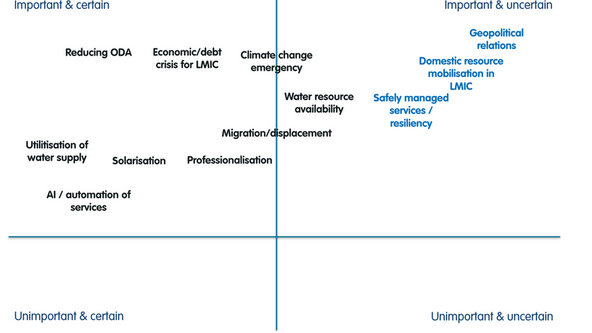
Selected trends through 2024 identified on the basis of a literature review and recent studies. Trends have been mapped according to importance and uncertainty, with the top right quadrant (important and uncertain) factors being the focus of the research