Article
Why sanitation services fail and how to diagnose the causes
Forthcoming working paper: “Strengthening Sanitation Systems: A Diagnostic Framework”
Why do sanitation services fail even when infrastructure is in place? A forthcoming Riva working paper introduces a practical framework for diagnosing where sanitation systems are breaking down and why.
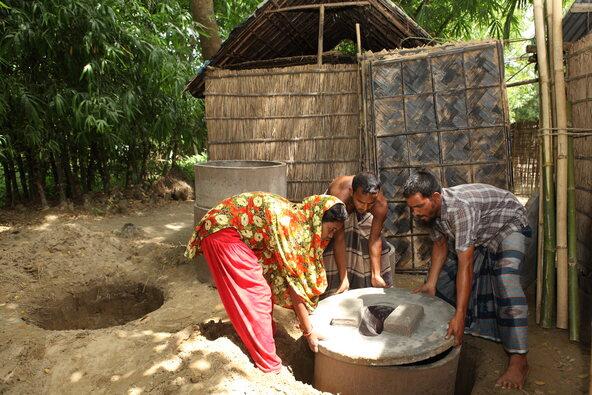
Across the Global South, a familiar pattern keeps repeating: toilets are built, a treatment plant is commissioned, and targets are met. A few years later, however, toilets are not in use, the plant is running far below capacity, or not at all, and the safely managed services they were meant to anchor have not taken hold. Infrastructure was delivered, but the service never became self-sustaining.
We are pleased to announce a forthcoming working paper that examines this issue from a systems lens. “Strengthening Sanitation Systems: A Diagnostic Framework” will be published by Riva next month.
What the paper does
The paper reiterates what Riva and our partners have known for years: sanitation outcomes depend on much more than hardware. Policy, institutions, planning, finance, regulation, capacity and accountability all shape whether a service works and keeps working. Practitioners agree on this in principle, but there are few practical ways to see which parts of a system are weak in a particular place.
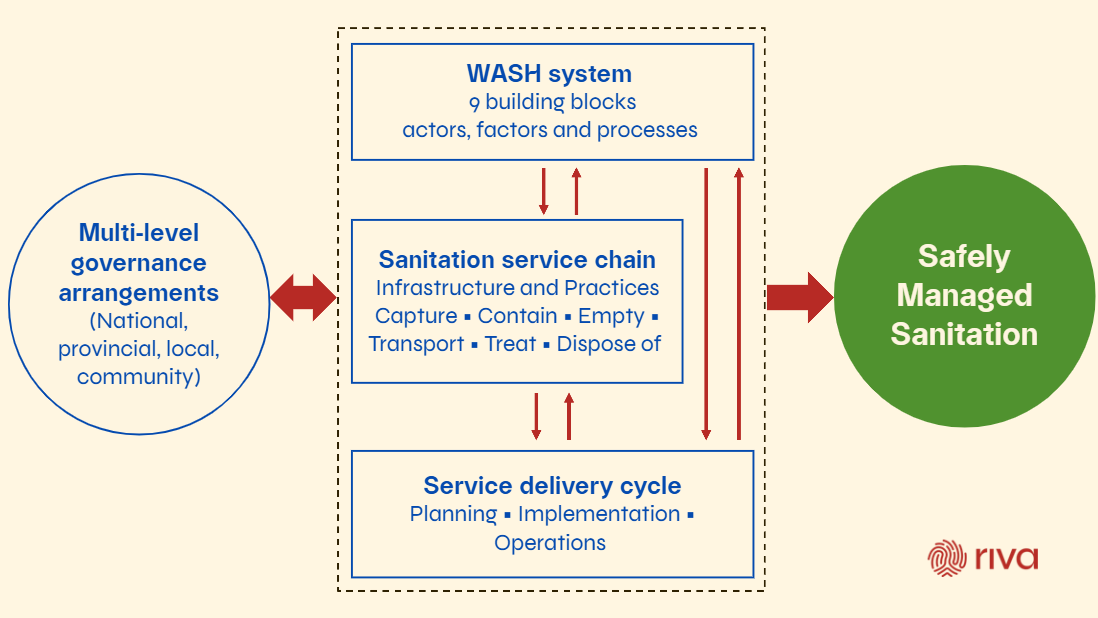
The paper offers a diagnostic framework that brings together three concepts: the sanitation service chain, the WASH system and the service delivery cycle. Earlier work has typically combined two of these at a time. This framework brings all three together. It also takes into account that governance arrangements differ across levels and contexts (see figure 1). The aim is to help governments, funders and practitioners identify the binding constraints in a particular setting, rather than assume that more infrastructure is the answer.
Reading the figure
- The sanitation service chain covers the infrastructure and practices through which waste moves, from capture and containment to emptying, transport, treatment and disposal.
- The WASH system is the set of conditions that determine whether the chain works in practice. We describe it through nine building blocks, covering the actors, factors and processes involved.
- The service delivery cycle follows a service through planning, implementation and operations, and shows where services tend to stall.
Each of the above concepts explains part of why services falter, and the arrows in the figure show that they influence one another. A weakness in one can undermine the others.
Governance at every level
The three elements operate within multi-level governance arrangements, shown on the left of the figure. Responsibility for sanitation is spread across national, provincial, local and community levels, and arrangements vary widely between and within countries. The same building block can be strong at one level and weak at another. The governance arrangements interact with each element, and together they deliver safely managed sanitation, the outcome on the right.
The paper does not set infrastructure against systems strengthening. Drawing on the cumulative perspectives view of sanitation’s history, it argues that the two are additive: systems work is what allows infrastructure investment to deliver lasting benefits.
Putting the framework to work
We apply the framework to faecal sludge management in India, tracing how the elements in the figure came together, or did not, as services moved from early demonstrations to wider adoption. The case study will be published separately, alongside a policy brief for decision makers who need the main messages without the full analysis.
What comes next
This is a working paper, and we want it to improve through use. If you work on sanitation, we would value your views on whether the framework matches what you see in your own context. Please write to communications@riva.org
The paper will be available on the Riva website and shared via LinkedIn. Follow us here.