Article
When the mirror turns: water, sanitation and hygiene challenges in high-income countries
A global perspective on the growing gaps in water, sanitation and hygiene that wealthy nations can no longer ignore.
Over two decades of working to improve water, sanitation, and hygiene (WASH) in low- and low-middle-income countries teach you to spot a broken system. You learn its signs — the institutional gaps, the missing accountability, the communities quietly left behind. So it is with embarrassment that I find myself recognising those same signs increasingly in some of the world's wealthiest nations.
The challenges that define the WASH crisis in the Global South — inadequate infrastructure, weak regulation, failure of accountability, and the erosion of human dignity — are appearing in new forms in high-income countries too. And we would do well to pay attention.
Two million Americans without safe water
The United States, the world's largest economy, has more than two million people without access to safe, running water or a working toilet at home. Our One For All member, Water For People, together with other civil society organisations, unearthed this startling figure. They live in Tribal communities, Appalachian hollows, rural Black Belt communities across the South, and in urban neighbourhoods just beyond municipal service lines (see the Vessel Collective National Roadmap for more info).
What is striking, from a global WASH perspective, is how familiar the diagnosis sounds. The roadmap identifies three core failures: the problem has been invisible, government investment has never matched the need, and support systems do not reach the communities that need them most. These are not uniquely American problems. They are system problems — and they are exactly what we observe when WASH systems fail anywhere in the world.
The disappearing public toilet: a Dutch crisis
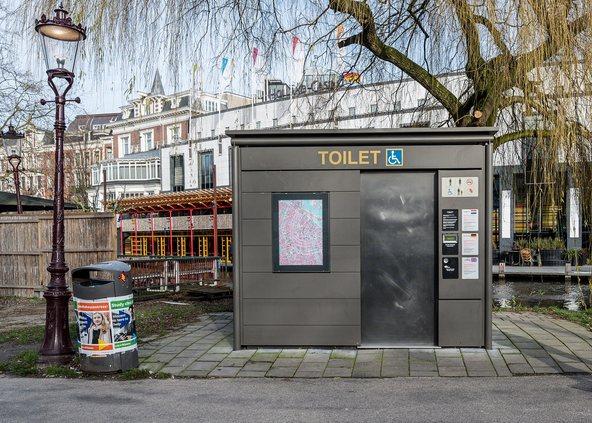
Across Northern Europe, a quieter but no less significant issue is unfolding. In the Netherlands, the shortage of public toilets has become a national conversation — and the numbers are striking. Research by the MDL Fonds (the Dutch gastrointestinal diseases foundation) and the Toilet Alliance Netherlands has found that three quarters of Dutch municipalities score poorly for public toilet provision. Amsterdam, once considered a relatively toilet-friendly city, has been losing ground.
View this map with public toilet access in the Netherlands.
The MDL Fonds estimates that nearly one in four people stay home because they are afraid of not being able to find a toilet in time. The campaign 'Iedere wc telt' — Every toilet counts — brings together civil society, local governments, businesses, and patient organisations to push for change. Dutch innovators have created the app HogeNood (Urgent Need), and globally there is the Freepee map that maps public restrooms across cities.
Also schools are affected. The same research highlights problematic access to toilets in schools — particularly at secondary level — with pupils postponing toileting. This has real consequences for bowel health, and can disproportionally affect girls and children with medical conditions.
The economic dimension is rarely discussed, but it matters. When people with bladder conditions, bowel diseases, or increased urgency that comes with age cannot rely on finding a toilet, they are less likely to go out. They shop online instead. This is a largely overlooked factor contributing to declining footfall on high streets across Northern Europe. What is often presented as a retail crisis also has, in part, a sanitation dimension.
Rivers, coastlines, and the demand for accountability
England offers perhaps the starkest example of accountability failure in the WASH sector. In recent years, there has been heightened public and political scrutiny of sewage discharges into rivers and coastal waters. Water companies have released untreated or partially treated sewage with alarming frequency, leading to degraded river ecosystems and polluted beaches.
What has been remarkable — and genuinely encouraging — is the civic response. Campaigning organisations (Surfers against Sewage), citizen scientists (River Wey), and community groups have mobilised with energy to demand transparency and accountability from water companies and regulators. Their methods — data gathering, public pressure, legal challenge — closely resemble the accountability mechanisms we seek to embed in WASH systems in low-income contexts. The principle is the same: systems must answer to the people they serve.
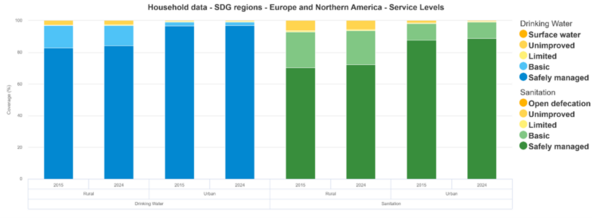
Diagram showing JMP household data from Europe and North America
Looking more closely, however, and the report's focus on inequalities reveals a more uncomfortable picture. Even within high-income countries, WASH service levels vary significantly - between communities with and without road access, between minority ethnic and Indigenous groups and the wider population, and between people with and without disabilities. The 2 million Americans without access to safe water are a striking example of these disparities.
There is also a telling methodological limitation in the JMP's own indicator guidance: in high-income countries where household surveys do not collect detailed information on the types of facilities people use, the programme relies on administrative records. The granular inequality data that the JMP routinely produces for low-income countries is actually harder to obtain for wealthy ones — because the assumption of universal coverage has led to underinvestment in monitoring. What you do not measure, you cannot fix.
This monitoring blind spot is itself a governance failure. The JMP tracks household access, but it does not capture affordability, reliability of supply, public sanitation provision, or the quality of wastewater management — the very areas where high-income countries are increasingly failing. A country can record near-universal basic household coverage, while its rivers run with sewage, its city centres lack public toilets, and millions struggle to pay their water bills. The data will not flag any of this.
A framework for diagnosis
At IRC, we work with a building blocks framework for assessing WASH systems — examining each component to understand what is functioning and what is not. These building blocks include infrastructure, finance, planning, institutional coordination, water resource management, and the capacity to learn and adapt. But two stand out as particularly critical: policy & legislation and regulation & accountability.
When we apply this lens to the high-income country examples above, we see that infrastructure exists, but it is ageing and (particularly in America) not undergoing the large-scale repairs required (CapManEx). Finance flows, but not always to where it is most needed (Public toilets need public conveniences). And in too many cases, the policy and regulatory frameworks that should guarantee safe water, functioning sanitation, and public access to toilets are unenforced, or simply not fit for purpose. Accountability — the mechanism that should correct all these failures — is the last line of defence, and it is under strain.
The JMP's framing of its 2025 report as a 'special focus on inequalities' is telling. The global monitoring community is beginning to acknowledge that the story of WASH progress is not simply one of rich countries having solved the problem and poorer countries catching up. The inequalities are structural, they persist within wealthy nations, and they will not diminish without deliberate policy action.
The climate crisis will put even more strain on this. JMP’s own considerations are to go for safe and resilient services post 2030. Check out our climate resilient WASH services course at the Systems Academy for more inspiration.
A challenge to governments in Northern Europe
Those of us who work in global WASH are accustomed to calling on governments to act. We do so again now, and this time closer to home.
We challenge governments in Northern Europe to constructively think about how they can secure and strengthen access to sanitation in public spaces, and access to drinking water throughout their countries. Not as an afterthought. Not as a footnote to urban planning. But as a genuine policy priority, rooted in the recognition that access to water and sanitation is a matter of human dignity — one that does not cease to apply once a country crosses an income threshold.
---------------------------------------------------------------------------------------------------
This blog has been written by Arjen Naafs, supported by Claude Sonnet 4.6, with the author retaining full responsibility for the content. Contributions and peer review by Tettje van Daalen.