Article
Water4Change: Solutions for three water-sensitive cities in India
Cities, with their fast-growing populations, climate variability, and challenging economic conditions, place increasing pressure on water resources. Bhopal, Bhuj and Kozhikode are three cities in India having to cope with these challenges.
The growing pressure threatens the sustainability and reliability of water services, particularly for marginalised populations, and undermines urban sanitation. There is therefore a need to design and plan cities that function well while alleviating pressure on water resources. Monash University came up with the concept of ‘water-sensitive cities’. “A water sensitive city is:
- productive – efficient and diverse water sources provide the water security essential for economic prosperity
- sustainable – water systems enhance and protect the health of waterways and wetlands, the river basins that surround them, and the coast and bays
- resilient – water systems mitigate flood risk and damage
- liveable – public spaces collect, clean, and recycle water.”
They add that a water sensitive city can serve as a water catchment area, provide a healthy natural environment, and that citizens demonstrate positive water behaviour.
Several organisations have since developed tools to provide the best solution to address the requirements for water sensitive planning and design for their context. For instance, the Centre for Science and Environment, based in New Delhi, in 2023, published a framework that takes the planned and the unplanned areas of a city into consideration. From an inclusion and social justice perspective, the framework proposes developing longer term plans for cities, recognising the challenges posed by climate change and developing mitigation strategies to address them, and improving the functionality and efficiency of infrastructure.
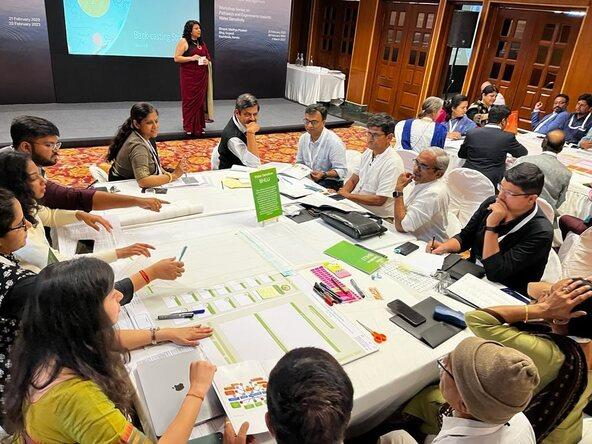
Rooted in the Global majority, Water4Change (2019-2025), a joint project funded by the Dutch Research Council (NWO) and the Department of Science and Technology, Government of India, provided another framework. Focusing on three fast-growing secondary cities of India – Bhopal, Bhuj and Kozhikode – the project applied a multi-disciplinary lens to move beyond purely techno-managerial solutions. The integrative approach of the project combined solutions across four domains - society, the built and natural environment, infrastructure and technology, and governance. This multi-disciplinary approach was made possible by bringing together a diverse group of academics and practitioners from 11 institutions, involving 45 professionals for five years.
Based on the multistakeholder consultations and on-the-ground research, three policy briefs have been produced, focusing on city-specific solutions to improve the sustainability, resilience and inclusiveness of urban water management. These briefs can be found here.
For other key outcomes of the project, please visit the homepage of the Water4Change project website managed by Drift.