Article
Water and sanitation: Moving beyond the aid debate towards financial credibility
This blog is not a global diagnosis. It is grounded in the African context, which has been my professional focus for two decades.
Africa needs financial credibility—not another debate about aid.
When Devex published the article “Water and sanitation fall through the cracks of development” last week, I read it with a mix of agreement and unease. Agreement, because yes, water and sanitation remain chronically underfunded. Unease, because the framing risks perpetuating a narrative I have heard for two decades in Africa: that the solution lies in “more aid.” After twenty years of working in water governance, financing, and institutional reform across the continent, I have come to a different conclusion.
This blog is not a global diagnosis. It is grounded in the African context, which has been my professional focus for two decades. And my message is simple: dwelling on the debate over insufficient aid is not only disempowering, it is also misleading. The real issue is financial credibility.
The limits of the aid narrative
The Devex article correctly highlights the financing gap: billions of people still lack safe water and sanitation, and the resources mobilised are far below what is needed. But it places too much emphasis on external aid flows. This is misleading for at least three reasons.
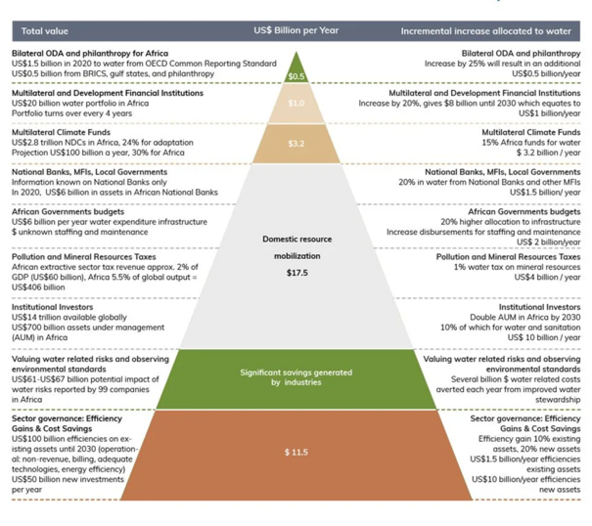
- Aid plays a marginal role in overall water sector financing. Globally, official development assistance (ODA) to water and sanitation hovers around USD 8–9 billion annually. Yet in practice, more than 90% of expenditure on water in developing countries already comes from domestic public budgets, not aid. According to the African Union’s International High-Level Panel on Water Investments, Africa’s financing needs are about USD 30 billion per year, of which only USD 0.5 billion is realistically expected from bilateral ODA and philanthropy.
- Aid can at best be catalytic. If it is used to plug capital gaps, it will never be sufficient to meet the overall financing needs. If instead it is used strategically—to support reforms that make systems investable—it can have outsized impact. Unfortunately, the article glosses over this distinction.
- Aid dependency has blinded us to structural blockages. For too long, the sector has been trained to “ask for more,” rather than to confront why resources—domestic or external—do not flow into water and sanitation at scale.
The AIP Investment Pyramid: where the real priorities lie
The African Union’s High-Level Panel on Water Investments presents a pyramid that clarifies where Africa’s water finance must come from. At its base is sector governance, worth about USD 11.5 billion annually, achieved through efficiency gains, stronger tax effort, responsible tariffs, and local finance discipline. Building on this, the second layer is domestic resource mobilisation, where institutional investors, targeted levies on pollution and mineral resources, government budgets, and national development banks together can generate around USD 17.5 billion each year. The third layer is multilateral and global capital—climate funds and development finance institutions—which could provide roughly USD 4.2 billion annually. Only if countries demonstrate financial credibility and prepare bankable pipelines can both the second and third layers be unlocked. Finally, at the top, the smallest slice is bilateral ODA and philanthropy, just USD 0.5 billion annually. Their value lies in catalytic use—accelerating reforms, offering risk guarantees, and supporting project preparation—not in closing Africa’s USD 30 billion gap. The pyramid makes one point unmistakably clear: the future of water and sanitation finance in Africa rests primarily on domestic credibility and mobilisation, with external flows playing a supportive, not central, role.
When credibility attracts capital: lessons from Benin and Uganda
Benin
In 2016, Benin elevated water to a national development priority. Macro-fiscal reforms improved public financial management and raised the tax-to-GDP ratio. Sectoral reforms created a dedicated rural water agency (ANAEPMR) to oversee Public-Private Partnerships, and restructured the urban utility SONEB to strengthen its effectiveness and improve performance.
The results were tangible. In 2021, Benin issued a €500 million SDG-linked Eurobond—a first for the country—alongside major concessional financing from the World Bank, African Development Bank (AfDB), Banque Ouest Africaine de Développement (BOAD), Agence Française de Développement (AFD), and others. Rural drinking water coverage rose from 54% in 2019 to 79.4% by the end of 2023. Reform built credibility; credibility unlocked repayable finance; finance delivered services.
Uganda
Uganda’s National Water and Sewerage Corporation (NWSC) has been transforming steadily since 1995, under consistent political and technical leadership. Internal performance contracts, digital billing, and decentralised services professionalised the utility.
By 2024, NWSC’s asset base had grown sixfold, turnover had tripled, and its network expanded from 8,100 km to over 19,000 km. Its customer base more than doubled. Crucially, NWSC accessed commercial finance: a UGX 50 billion (USD 13 million) loan from Equity Bank, and capacity to issue up to USD 200 million in bonds. This was possible because reforms had built investor confidence.
These cases underline a principle too often ignored: Without credible reforms, money either does not flow or fails to deliver lasting impact.
Debt, not aid, is the real fiscal trap
This is where the perspective of Esther Duflo, 2019 Nobel Prize winner in Economics, brings clarity. In a recent interview to Jeune Afrique, she dismantled the myth of aid dependence:
- “In Africa, where the majority of public expenditure already comes from national tax revenues, aid had assumed a symbolic or political importance far beyond its actual weight.”
- “Very few African countries actually depend on aid. What undermines their budgets are debt crises and trade-related shocks.”
- “In several African countries, debt servicing is sometimes higher than the budget allocated to education or health.”
- “This debt crisis is not due to irresponsible behaviour by African countries. It is linked to the rise in interest rates, a consequence of anti-inflationary policies conducted in Europe and the United States. These policies do not take into account their harmful effects on the rest of the world.”
Her words echo what I have seen: aid is a distraction from the real fiscal straitjacket, which is unsustainable debt servicing driven by external monetary policies. In other words, Africa is suffocated not by the absence of grants, but by the cost of capital.
Shared but different responsibilities
This leads to a reframing of responsibilities.
- Developing countries’ responsibility is to strengthen their own credibility: professionalise utilities, enforce regulation, reform tariffs and subsidies, integrate water into fiscal planning, and mobilise domestic resources. No external actor can do this for them.
- Developed countries’ responsibility is not primarily to “give more aid,” but to rethink the conditions of repayable finance. Interest rates that reflect inflated perceptions of African risk, combined with global anti-inflation policies, are bleeding African budgets. If developed economies are serious about partnerships, they must create lending terms aligned with reform progress—not terms that punish countries for risks they are actively managing.
Moving beyond charity to solutions
For decades, our sector has repeated the same refrain: “water and sanitation are underfunded.” This is true, but it is not the root problem. What we need now is not another round of complaints, but a hard reset of our priorities.
- Stop overvaluing aid. Its role is marginal and should be catalytic, not foundational.
- Tackle financial credibility. This is the bridge between governance and finance. Without it, investment stalls. With it, investment flows. Benin and Uganda prove that systemic reforms pay dividends in both credibility and coverage.
- Confront the debt trap. The real asymmetry lies in the cost of capital and the externalisation of inflationary policies by advanced economies.
An invitation to Kigali 2026
These are not abstract debates. They are the questions we will confront directly at the Africa All Systems Leadership Symposium, Kigali, 2026. There, African leaders, development banks, investors, and civil society will gather not to dwell on aid, but to engage on sustainable solutions: financial credibility, systemic reform, and equitable access to capital.
I warmly invite all colleagues, policymakers, and partners who care about water and sanitation to join us in Kigali. It is time to stop circling around the problem in terms of insufficient aid and start building the solid foundations that Africa deserves.