Article
Stories of change through the Systems Academy
Achieving universal access to safe water and sanitation in Rwanda is a cornerstone of the country's development vision. However, ensuring sustainable services requires more than infrastructure; it demands robust systems, skilled professionals, and coordinated efforts at every level.
Recognizing this gap, the Isoko y'Ubuzima project through WASH introduced the Systems Academy to different WASH stakeholders in Rwanda. This is an online learning platform that offers a series of interactive courses aimed at equipping WASH professionals with the tools and knowledge to strengthen systems at all levels. The Academy addresses the capacity needs identified during national and district-level initial capacity assessments conducted by Isoko y'Ubuzima. Three courses were adapted specifically to the Rwandan context. This includes WASH systems strengthening for Rwanda, District planning for sustainable WASH services in Rwanda and Costing for district WASH planning in Rwanda.
By integrating technical knowledge with practical tools, the Academy has enabled professionals from different categories such as government national and district level staff, water supply private operators, members of youth-led companies, members of Rwanda Young Water Professionals (RYWP) and higher-learning institution lecturers to apply systems-thinking approaches to their work. But what truly sets the platform apart are the personal stories of transformation shared by those who were open to it.
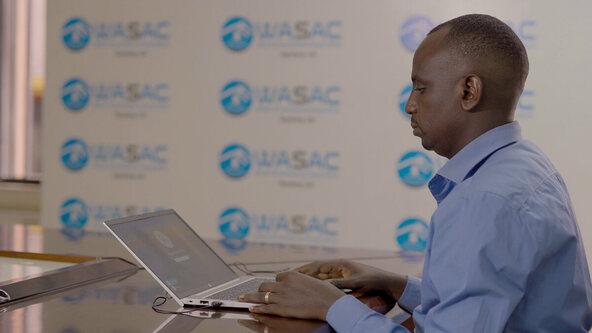
Moise Irankunda, a Geographic Information System (GIS) Specialist at the Water and Sanitation Corporation (WASAC),
For Moise Irankunda, a Geographic Information System (GIS) Specialist at the Water and Sanitation Corporation (WASAC), the WSA has redefined how he approaches project planning and execution.
"Of the four courses I took, two stood out-Costing for District Planning in WASH and Climate Resilience for WASH Services. These courses gave me new tools to improve our planning processes. For instance, we now require consultants to include climate resilience components in their project proposals, and two of such projects have already been validated. The costing course was equally transformative, helping me better understand operational and capital expenses, which is critical for sustainable service delivery" said Moise.
Moise's experience resonates with Eng. Emmanuel Hategekimana, a Rural Water Supply Senior Engineer at the Ministry of Infrastructure. Emmanuel explains how the courses have enhanced his ability to address district-level WASH challenges:
"The Costing for District WASH Planning course equipped me with the skills to apply Life-Cycle Costing tools, which are crucial for budgeting and resource mobilization as well as facilitating universal access to water and sanitation services in partnership with local stakeholders."
Emmanuel said Moise and Emmanuel's testimonies illustrate how the Academy fosters cross-sectoral collaboration. While apply their skills within the government setting, private sector actors like Cyubahiro Manzi Patrick, Managing Director of Axion Water Solution, a water operator company from Nyamagabe district – is also reaping the benefits. Patrick shares how the Building Blocks course reshaped his perspective:
"I used to think about projects as isolated tasks, but this course taught me that a successful project requires interconnected systems. For private operators like me, this knowledge ensures we can deliver sustainable services and respond effectively to community needs." Patrick shared.
The Systems Academy's impact extends beyond individual professionals to institutions. Charlotte Uwimpuhwe, an Assistant Lecturer at the University of Rwanda- Department of Civil, Environmental and Geomatics Engineering, School of Engineering, College of Science and Technology, highlights how she integrates lessons from the Academy into her teaching:
"The platform's evidence-based materials have transformed how I teach. When I discuss water demand with my students, I can't ignore topics like water losses, costs, and related challenges-all of which I learned through the WSA. I even encourage my students to register and explore these resources themselves. Personally, I can't wait for the holidays to take other courses like the Building Blocks one." Charlotte shared with excitement
This ripple effect is evident across the WASH ecosystem. Members of the Rwanda Young Water Professionals, like Jean Felix Habineza, have also found the Academy invaluable.
"The Building Blocks course gave me practical skills in planning and monitoring that I now use in the field. For example, during a recent customer mapping exercise assigned by Isoko y'Ubuzima, I felt confident in applying these tools. It's exciting to see how this knowledge translates into real-world impact." Said Jean Felix.
Laying the foundation for lasting change
In order to ensure that the Systems Academy continue shaping the sector, the hope is to continue to work with WASAC and look on how to integrate the Academy courses into its induction program for new staff. This initiative aligns with WASAC's vision of establishing a training center that will sustain capacity-building efforts long after the project ends.
The success of the Systems Academy reflects how targeted capacity-building initiatives can drive systemic change. Between January 2022 and December 2024, thanks to Isoko y'Ubuzima mobilization, 264 Professionals have completed courses, with many more enrolled and eager to continue learning. By equipping individuals with critical skills, the Academy is building a network of empowered professionals working together to achieve Rwanda's WASH goals.
This blog was originally published in 2024 when the Systems Academy was known as the WASH Systems Academy. Article was updated to reflect the new name.