Article
Positioning WASH in climate policy: The role of NDCs and NAPs
The Climate Champions at IRC explore a range of climate change topics and their relationship with water, sanitation, and hygiene (WASH). This blog examines the roles and implications of Nationally Determined Contributions (NDCs) and National Adaptation Plans (NAPs). It follows from a Climate Connect learning event within One For All and it is intended as an introductory piece for readers who are beginning to explore climate change issues.
What are NDCs and NAPs?
We often hear about NAPs and NDCs in climate discussions. Although these two abbreviations are frequently used in climate policy debates, their theoretical and practical implications are diverse and can vary significantly across sectors and contexts. Nationally Determined Contributions (NDCs) and National Adaptation Plans (NAPs) have become central policy frameworks guiding how countries respond to climate risks.
Why is it relevant?
Climate change is water change. Climate change is already altering rainfall patterns, intensifying floods and droughts, and increasing risks to water quantity as well as quality and sanitation infrastructure. Because water security, sanitation systems, and hygiene practices are directly affected by climate variability, the WASH sector is closely linked to both adaptation and mitigation agendas. Understanding how WASH is reflected in NDCs and NAPs is therefore essential for aligning efforts to ensure safe and resilient WASH services with climate policy (you can see this video to know more).
Examples where WASH is well positioned in the NDCs and NAPs
While most countries mention water broadly in the context of adaptation or water resources management, only a smaller group have explicit and detailed WASH‑related activities or targets in their NDCs. Bolivia and Uganda are examples of countries that include detailed WASH activities, particularly sanitation-related, in their NDCs, with clear targets and interventions. Bolivia’s NDC commits to climate-resilient and equitable sanitation systems, including improved sewerage, wastewater treatment, and reuse, measured through an integrated water management index. Uganda’s NDC similarly outlines sanitation-focused mitigation actions, such as school bio-latrines with biogas digesters, integrated wastewater treatment to reduce methane emissions, and the Planned Green Cities programme to improve wastewater efficiency in multiple municipalities.
Countries are expected to update their NDCs every five years. Rwanda provides a good example of this process, having progressively strengthened its NDCs in 2015, 2020 and 2025 with more detailed and ambitious targets. In its latest NDC, WASH is more clearly integrated. The document notes that extreme weather events threaten progress towards universal access to water and sanitation and may divert resources from service expansion to infrastructure repair. It therefore commits to achieving universal, climate-resilient WASH services by 2030. Planned measures include expanding water supply networks, introducing solar-powered water treatment facilities, and retrofitting sewerage systems in climate-risk areas with flood protection and erosion control measures.
Bangladesh provides a good example through its NAP (2023–2050), where WASH is identified as key cross-cutting areas alongside sectors such as water resources, disaster risk reduction, agriculture, ecosystems and urban development. The NAP highlights WASH as an important consideration when assessing climate vulnerabilities and planning adaptation strategies across multiple sectors, reflecting the understanding that resilient water and sanitation services are essential for coping with climate impacts such as floods, droughts and water scarcity.
How it helps
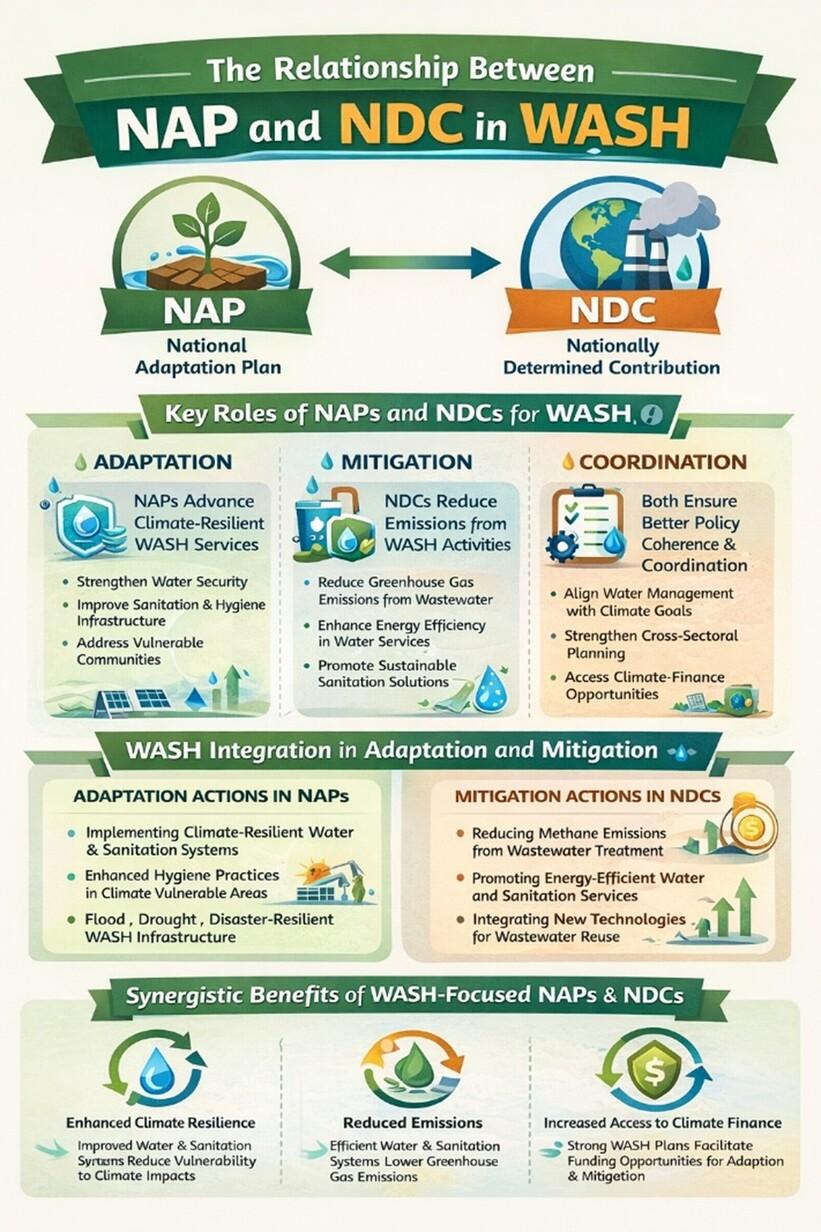
Integrating WASH into NAPs and NDCs can help countries access climate finance for actions that support both mitigation and adaptation. The role of NDCs in accessing climate finance is stronger than that of NAPs, but they do not automatically unlock funding. When a sector (for example water or sanitation) is clearly identified in the NDC, it becomes easier for governments and donors to justify investments in that sector. Many countries use their NDCs as a strategic framework to develop climate investment pipelines which later become proposals for GCF or other climate funds (e.g. Senegal). NDCs are also relevant for carbon credit mechanisms, especially under the Paris Agreement, the carbon market framework is known as Article 6. In this context, NDCs matter because they define:
- the country’s national emissions target
- which emission reductions count towards that target
- which reductions can potentially be transferred internationally as carbon credits
However, having an NAP does not provide direct or fast-track access to funding, for example from the Green Climate Fund (GCF). Projects seeking GCF support must go through a full preparation and due-diligence process. Nevertheless, NAPs can strengthen the strategic justification for funding proposals, as they often identify priority adaptation investments that can later be developed into project proposals. The GCF also provides NAP readiness support through its Readiness and Preparatory Support Programme, which helps countries to develop or update their NAPs and strengthen their capacity to access and use climate finance. The programme offers up to USD 3 million per country to support national adaptation planning, particularly for vulnerable countries such as Least Developed Countries (LDCs), Small Island Developing States (SIDS), and African states. Countries such as Bangladesh, Cambodia, Malawi and Zambia have already accessed this support.
What does this mean for WASH professionals?
- Engage early in NDC and NAP processes through national coordination mechanisms
- Ensure WASH is framed as both an adaptation, and, where relevant, mitigation opportunity
- Align sector plans (e.g. master plans, investment plans) with national climate priorities
- Use NDCs and NAPs to position WASH projects for climate finance
NAPs and NDCs are complementary climate policy frameworks that guide countries’ responses to climate change. While NAPs focus on long-term adaptation planning, NDCs outline national climate commitments on mitigation and increasingly adaptation. Integrating WASH within both frameworks helps strengthen climate-resilient water and sanitation systems and improves access to climate finance for the sector.
What are NDCs and NAPs?
We often hear about NAPs and NDCs in climate discussions. Although these two abbreviations are frequently used in climate policy debates, their theoretical and practical implications are diverse and can vary significantly across sectors and contexts. Nationally Determined Contributions (NDCs) and National Adaptation Plans (NAPs) have become central policy frameworks guiding how countries respond to climate risks.
Why is it relevant?
Climate change is water change. Climate change is already altering rainfall patterns, intensifying floods and droughts, and increasing risks to water quantity as well as quality and sanitation infrastructure. Because water security, sanitation systems, and hygiene practices are directly affected by climate variability, the WASH sector is closely linked to both adaptation and mitigation agendas. Understanding how WASH is reflected in NDCs and NAPs is therefore essential for aligning efforts to ensure safe and resilient WASH services with climate policy (you can see this video to know more).
How are they developed?
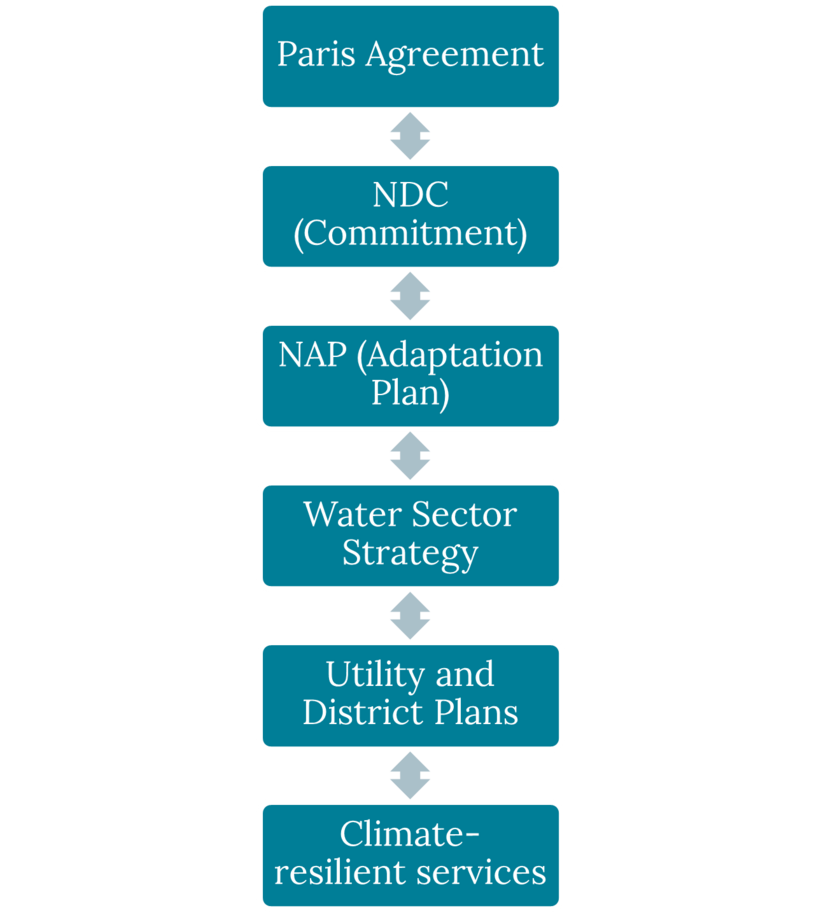
NDC emerged from the Paris Agreement 2015. Under this agreement, every country committed to National Determined Contributions that outline how it intends to reduce greenhouse gas emissions and address climate impacts. The system is based on the principle of “national determination,” meaning that countries set their own targets and strategies rather than following a top-down global mandate. In practice, the preparation of an NDC usually involves a coordinated process led by a national ministry—which compiles greenhouse gas inventories, develops emissions projections in consultation with relevant sectoral ministries. Some governments consulted academia and civil society stakeholders as well. The completed NDC is then submitted to the United Nations Framework Convention on Climate Change (UNFCCC) and countries are expected to update their NDCs every five years. Around 130 out of the 195 signatories to the Paris agreement have submitted new NDCs in the latest round of 2025/2026. The number of NDCs containing adaptation information has increased compared to previous NDCs. Traditionally NDCs were primarily associated with mitigation, but as indicated most countries now also include adaptation components. According to UNFCCC NDC Synthesis Report (2024) and the LDC Expert group, about 81% of countries have incorporated adaptation measures in their latest NDC updates. Within these plans, WASH is generally framed as an adaptation issue.
NAPs were established under the Cancún Agreements 2010 to help countries systematically plan for long-term climate adaptation. Unlike NDCs, NAPs focus specifically on adaptation and countries are encouraged, but not legally bound, to submit NAPs. In practice, preparing an NAP is a multi-year process, typically involves establishing national coordination mechanisms, conducting climate risk and vulnerability assessments, and undertaking sectoral analyses in areas such as water, agriculture, health, and infrastructure. Governments then prioritise adaptation actions, identify implementation strategies and financing options, and integrate these priorities into existing policies and development plans. 75 countries have officially submitted their NAPs to the UNFCCC.
With the end of the SDG period approaching, the importance of NAPs has been reinforced through the Global Goal on Adaptation (GGA) and the Global Stocktake. The GGA provides a framework for evaluating seven key thematic areas for adaptation: water, health, biodiversity, food, infrastructure, poverty and heritage. It also captures the four steps of the adaptation process: 1) assessing impacts, vulnerabilities and risks, 2) planning adaptation measures; 3) implementing the planned adaptation measures; and 4) monitoring, evaluation and learning. The first Global Stocktake highlighted the lack of sufficient data to assess the adequacy of current adaptation measures and the need to accelerate adaptation action (read more here).