News
National WASH building blocks reflection in Uganda
Collective action for stronger WASH systems
Uganda's WASH sector reviews progress and sets national priorities
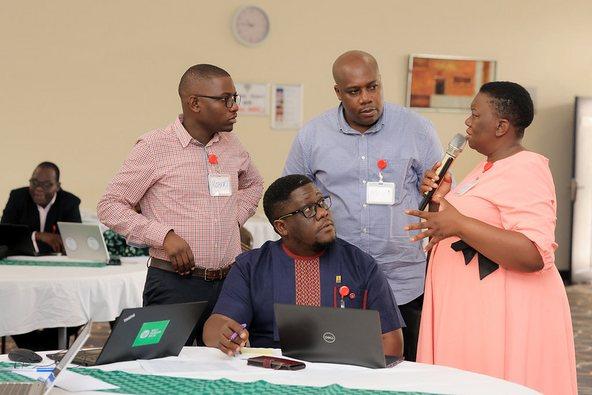
We scored the nine building blocks with our government partners, civil society organisations, and financial institutions. We now know where we stand. Where we have gone up and where we have gone down. We have improved on inclusive planning, and greatly improved on regulation and accountability.
Jane Nabunnya Mulumba, CEO, Riva Uganda
Key discussions
The workshop reaffirmed that achieving sustainable WASH services requires coordinated action across the nine WASH Building Blocks. Participants acknowledged that Uganda has made progress in strengthening coordination among the Ministries of Water and Environment, Health, Education and Sports, Local Government, and development partners. However, implementation gaps remain, particularly at district level.
A high-level panel emphasised several recurring challenges:
- Financing remains the sector's biggest constraint despite increased overall WASH funding, with domestic financing and operation and maintenance (O&M) receiving inadequate investment.
- Coordination mechanisms have improved, but implementation and enforcement continue to lag behind policy commitments.
- Sanitation and hygiene continue to receive less attention than water supply, particularly at local government level.
- Political leadership and accountability need to translate commitments into protected budgets and improved service delivery.
- Monitoring, data systems and water quality surveillance require strengthening to support evidence-based planning and reporting.
Building block assessment highlights
The updated July 2026 assessment recorded an overall composite score of 65.6%, compared to the 69.7% baseline (September 2024), reflecting more rigorous evidence-based validation rather than necessarily indicating sector regression.
Notable improvements were observed in:
- Demand, behaviour and political will (+14.3 percentage points)
- Inclusive planning (+7.1 percentage points)
- Finance (+7.1 percentage points)
Areas requiring the greatest attention include:
- Learning and adaptation (50%)
- Finance (57.1%)
- Monitoring (57.1%)
- Regulation and accountability (64.3%)
National priority actions
Participants agreed that future efforts should focus on:
- Strengthening sustainable and domestic financing for WASH, including dedicated O&M funding.
- Improving regulation, accountability and enforcement of existing policies.
- Enhancing district-level institutional capacity and coordination.
- Strengthening monitoring systems, harmonising sector data and improving SDG 6 reporting.
- Investing in routine water quality monitoring and water resources management.
- Promoting political leadership, community ownership and behaviour change.
- Revitalising learning platforms to ensure knowledge is translated into improved practice.
- Clarifying institutional roles, strengthening asset management and improving sustainability planning.
Way forward
The nationally agreed priorities will inform a subsequent Agenda for Change partners' meeting, where coalition members will identify the priority actions they will collectively champion. The workshop concluded with a call for stronger government leadership, increased domestic investment, and continued multi-stakeholder collaboration to accelerate WASH systems transformation and sustainable service delivery in Uganda.