Article
Moving towards sustaining services: Proceedings from India International Water Week
“…it is about time to move the discussion from creation of assets to sustainability of services…” The 8th Water Leaders’ Forum (WLF) session at the 9th India International Water Week (IIWW) 2026 opened with this statement.
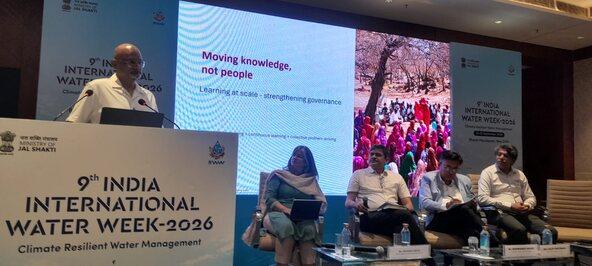
This session, on ‘Rural Water Supply Governance and Implementation Frameworks – Strengthening WASH Systems of Sustainable and Equitable Services’, was organised on 25th September -the final day of the 9th IIWW, jointly by the Ministry of Jal Shakti, Government of India, Water For People India and Riva. The session, split into two parts, was chaired by Sujoy Mojumdar, UNICEF, with Bishwadeep Ghose, Water For People India, and Ruchika Shiva, Riva, as co-chairs.
The first part of the session focused on professionalised services in rural areas anchored by Gram Panchayats as micro utilities. The speakers in this session included VS Choudary Kolasani (IAS), Managing Director, Jal Nigam, Government of Madhya Pradesh, Anupam Srivastava, Executive Engineer, Ground Water Department, Uttar Pradesh, and Nitin Bassi, Senior Fellow, Council on Energy, Environment and Water.
The session was kickstarted by the acknowledgement that the Jal Jeevan Mission (JJM) has been a game changer in terms of the scale of public finance invested and infrastructure created to provide household piped water supply to 255,000 Gram Panchayats. The current need, however, is to move the conversation from the infrastructure creation stage to ensuring ongoing services.
The JJM guidelines put Gram Panchayats (and their sub-committees) at the centre of delivering safe water services - planning, operations, maintenance, financial management, monitoring, and so on. But Gram Panchayats need an enabling environment to perform as envisioned. The Madhya Pradesh Operation and Maintenance Rules of 2026 under JJM was cited as an attempt made in this direction.
The discussion brought to the fore some ways to strengthen institutions for Gram Panchayats to function to ensure sustainability of schemes. These were:
- Clarifying roles, responsibilities and powers of the various stakeholders involved in provision of drinking water, including block- and district-level Panchayats.
- Capacitating the stakeholders with the knowledge and skills to perform their roles, such as planning and financial management for Gram Panchayats.
- Strengthening Gram Panchayats by entrusting them with the power to collect tariffs, disconnect on non-payment or impose penalties
- Using simple and relatable terminology for committees - such as ‘Water/ Pani Committee’ (compared to Village Water Security Committee) – for improved understanding of the members on the purpose of the committee and their role therein.
- Providing flexibility to Gram Panchayats in generating revenues and expenditures.
- Focusing on Operations and Maintenance to ensure sustainability of schemes.
- Introducing IT initiatives to improve operational efficiency, such as IT-enabled payment mechanisms to facilitate tariff collection.
In addition to institutions, strengthening water resource management and climate resilience are critical for sustaining services. This is especially true for groundwater dependent schemes, such as in Uttar Pradesh, where more than 88% of drinking water schemes are groundwater based.
The discussion identified the following measures to help ensure the sustainability of water sources:
- Real-time monitoring of water resources
- Focusing on demand-side interventions at the community level, such as behaviour- change, information education communication activities, including using local dialect for community dialogue, and the engagement of local water champions to prioritise water conservation.
- Adopting a scientific approach to mapping and identifying water bodies located near source wells and focusing on their revival.
- Interdepartmental collaboration (for instance, between groundwater and drinking water departments) for sharing and exchange of data for holistic planning.
- Factoring climate conditions into the planning and design stage of the scheme.
- Safely managing waste (faecal, solid and liquid) to protect the quality of water resources.
This part of the session highlighted that fostering community ownership is both a contributory factor and an outcome of sustained services. Engaging the community from the outset, including in water resource surveys and in the planning and implementation of schemes, helps build a sense of ownership and responsibility. This in turn contributes to the sustainability of services. “….We must do away with the concept of handover – that of planned and built by someone and managed by someone else…” At the same time, continued service delivery is an effective mechanism to ensure tariff collection and foster community ownership. “…People are willing to pay if the services are regular….” Convergence has to be sought from the bottom up: between communities and the line departments, between representatives of different units, within departments, and between departments.
The second part of the session focused on strengthening governance through technology. The speakers in this session included Vivek Sharan, Water For People and Sanjay Joshie, ECHO India.
The speakers highlighted several ways in which technology could be leveraged to strengthen systems at scale:
- Providing regular capacity-building interventions through e-learning platforms and social media, rather than relying on one-off training events.
- Using real-time monitoring services for corrective action.
- Promoting digital payment methods to increase transaction transparency and facilitate tariff collection.
- Developing unified monitoring dashboards to support convergent planning and decision-making.
This part of the session highlighted the need to use technology to reimagine capacity building at scale. This reimagination requires creating a common knowledge space, focusing on ground realities, informed by both experts and peers. The learning has to be provided in small amounts and at regular intervals to avoid overwhelming learners.
To conclude, the discussion highlighted that Gram Panchayats need to be empowered to support the professionalisation of rural water supply services. This empowerment results from the creation of an enabling environment that engages them in decision-making from the very beginning, provides them with the flexibility to carry out their functions, and ensures that they receive the requisite training and awareness. At the same time, it is critical to factor in climatic considerations and source sustainability to sustain services.