Article
Institutionalising water scheme monitoring in Ari Zone
A transformative step towards sustainable WASH services
Ari Zone scaled mWater monitoring system, strengthening governance, coordination, and evidence-based water management
Strong monitoring systems are essential for ensuring reliable water services and enabling governments to make informed decisions that improve service delivery
Reliable and transparent data systems are foundational for delivering sustainable drinking water services. In Ari Zone, Southern Ethiopia Region, this principle has been put into practice through the successful institutionalisation of the mWater monitoring system, marking a significant milestone in strengthening WASH governance and accountability across the Zone. Scaling up a digital monitoring system across the Zone.
Since the introduction of the cloud-based mWater monitoring system in South Ari Woreda in 2017, with support from IRC, the system has steadily evolved from a woreda-level pilot to a fully operational, zone-wide platform. Over the years, improvements in staff capacity, leadership commitment, and data use culture have accelerated its expansion.
This experience from South Ari Woreda highlighted the importance of a digitised monitoring system and informed the decision to scale it up to the Zonal level. Accordingly, the Ari Zone Water, Mines, and Energy Department designed standardised indicators and conducted a one-time zonal water system survey in 2023, and ad hoc zone-wide functionality update surveys are being used to monitor water scheme functionality, detail causes of non-functionality, and propose maintenance actions. Whenever the woreda enumerator updates the system, all data are automatically synchronised to the zonal centralised visualisation dashboard. The dashboard is accessible to both woreda and zonal leadership for real-time data viewing and analysis; however, it is primarily used by the Zone Water, Mines and Energy Department for aggregated monitoring, performance tracking, and decision making.
The institutional capacity to operate and manage the system is now strong at both woreda and zonal levels. The joint memorandum of understanding (MoU), signed on November 25, 2025, between Ari Zone Water Mines and Energy Department and Water Mines and Energy Offices of South Ari, Baka Dawula Ari, Woba Ari, Semen Ari woredas, and the Town Water Utilities of Jinka, Gazer, and Gelila, formalises this collective commitment and establishes a unified framework for monitoring, data sharing, and decision making.
A coordinated approach to data for better water services
The newly established MoU serves as a cornerstone for improving sustainability and equitable access to safe drinking water. By adopting a centralised, coordinated information management system, Ari Zone now benefits from:
- Real-time and transparent data accessible through the mWater platform
- Consistent information flows across administrative levels
- Faster and evidence-based decision making
- Clear accountability among actors
- Efficient service delivery for communities
Ato Gizachew Belay, Head of Ari Zone WMED, described the confidence this shift has created:
After fully scaling up the zonal water scheme monitoring system, we are confident in our data reliability. We now have solid evidence to convince and advocate with partners and stakeholders.
Ato Gizachew Belay, Head of Ari Zone WMED
Previously, woredas have been experiencing repeated data requests from the Zone due to inconsistent reporting systems. Ato Ajele Getu, Head of South Ari WMEO, explained the change:
Before zonal scale-up, we were challenged by frequent data requests from the Zone, even though the information was already in the system, as South Ari Woreda has been using the system. Now, the Zone no longer asks us for data; they see the data on the system and only call us to confirm reliability. This shows the system is functioning well.
Ato Ajele Getu, Head of South Ari WMEO
For woredas like Semen Ari, the impact has been even more transformative. Ato Awoke Tekele reflected:
We did not have organised data before. It took days to collect and clean information from different sources. Now, with mWater, all our water schemes are updated. We can easily access survey forms, dashboards, and visualisations whenever needed
Ato Awoke Tekele, Semen Ari woreda
What the MoU brings
The Joint MoU outlines a robust framework including core areas of collaboration among woredas and town water utilities, partnership principles that promote transparency and shared responsibility, roles and responsibilities for each participating institution, and enforcement mechanisms and legal validity, ensuring sustainability.
This structured approach ensures the monitoring system is not dependent on individual staff but is anchored in institutional processes.
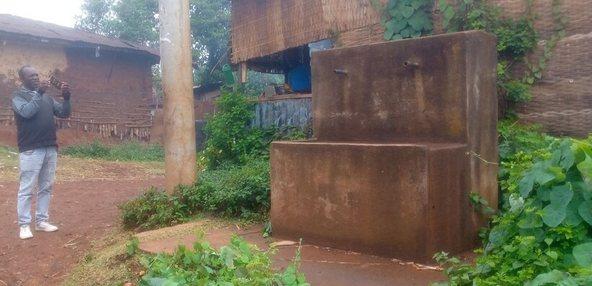
Enumerator collecting water scheme functionality data
The way forward
Institutionalising digital monitoring systems is a long-term undertaking. Ethiopia is currently working towards a unified national WASH monitoring platform, but such systems require years of commitment, alignment, and capacity building.
The Ari Zone experience demonstrates what is possible when local governments are empowered and dedicated. Over the past seven years, South Ari Woreda and Ari Zone, in collaboration with IRC WASH, have invested in training, equipment, system configuration, data collection, and continuous follow-up. These efforts have culminated in the full institutionalisation of the mWater system at the zonal level, a milestone that strengthens service sustainability and provides critical lessons for other regions in Ethiopia and beyond. By embracing a reliable, real-time monitoring platform and formalising collaboration through a joint MoU, the Zone has laid the foundation for stronger governance, improved service delivery, and long-term system sustainability.