
Article
Improving data use on water for people
During an interactive session at the Stockholm World Water Week, participants discussed how governments and their partners can improve the use of data on the provision of water and sanitation services, by monitoring, compiling, and using data along the entire service provision results chain. From financial inputs, via the strength of the systems, to actual services delivered.
The session had two main objectives:
- Identify good practices, opportunities and challenges for linking different types of data along the WASH results chain, for informing sectoral review, decision-making and accountability,
- Agree on a way forward on how governments, development partners, and civil society can build on the identified good practices and opportunities and overcome challenges.
The session involved a joint framing presentation, two case presentations, from Nepal and Nigeria, group work on challenges and opportunities, and a panel discussion on the way forward. This brief presents the main reflections from this session.
Setting the scene
The world is off-track on reaching Sustainable Development Goal 6. Current rates of progress are not sufficient to achieve SDG 6 by 2030. The process towards the 2028 UN Water Conference presents an opportunity to accelerate implementation, strengthen accountability and turn commitments into measurable action. In addition, efforts are ongoing to strengthen sectoral monitoring that can drive acceleration. These include the Align to Accelerate Initiative, the development of a guiding note (UNICEF, Riva and Akvo) on national monitoring, and FCDO’s WASH Systems for Health Project.
There is clear recognition of the need to monitor progress along the entire results chain, in order to inform sectoral decision-making and accountability.
Monitoring along the WASH service results chain
As shown in the figure below, there are different monitoring systems and initiatives covering different elements of the results chain. The case study from Cross River State, Nigeria presented a real-world example of this, showing that monitoring involved several monitoring systems, producing data sets along the results chain. These included data on inputs through WASH accounts, data on outputs, e.g. through functionality tracking, data on systems strength, through a WASH Systems Index tool, and data on service levels, through WASHNORM.
However, monitoring along the results chain is often siloed, without considering the whole chain, and is often not strongly linked to reflection, decision-making, and accountability processes.
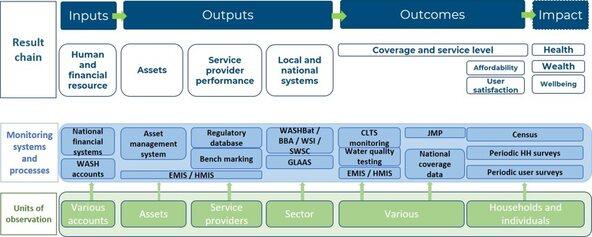
Different monitoring systems and initiatives covering different elements of the results chain
The case studies from Nigeria and Nepal presented examples of how data along the results chain was taken up and used by government. In the Nigeria case, monitoring findings were “not allowed to sit on the shelves” and were used by government to take action, including strengthening policies, accountability mechanisms, funding, and improved infrastructure management, which resulted in improved services. In Nepal, findings from the WASH Systems Index tool were used by the newly established provincial government to strengthen systems. This also led to the strengthening of monitoring systems and the use of monitoring data to inform planning at the local level and to advocate for and facilitate investments at the provincial and national levels.
When data are brought together along the results chain at national level, they provide insight into the state of the whole sector and of progress against set targets, which can inform:
- Sector reflection, e.g. through Joint Sector Review (JSR) processes, or tracking of progress on compacts, such as those under the Heads of State Initiatives (HoSI) and Water Forward;
- Decision making, including policy decisions, and macro-level planning and resource allocation decisions.
- And reporting for accountability, including upward accountability, to parliament and heads of state, and downward accountability towards citizens.
What is needed for this?
First of all, there needs to be clear purpose and demand for compiling and using data along the results chain. There is growing recognition that monitoring along the results chain is essential to accelerate progress towards SDG 6. This has been driven by a global push to monitor not only outcomes but also the “means of verification”, alongside growing adoption of systems approaches by governments and their partners. However, in many countries, actual national-level compilation, reflection, and use of data along the results chain has been limited. During the group work, lack of government prioritisation of data collection, and in particular, the timely updating, use and application, were identified as key challenges. Leadership was highlighted as the single most important factor, together with defining the decisions to be informed and building the data chain backwards from those decisions rather than collecting data indiscriminately.
Secondly, there is a need for strong monitoring systems for different elements of the results chain. In most countries, there are indeed monitoring systems in place covering different parts of the results chain. However, there are often gaps and overlaps. And these systems are not always very strong to begin with. During the group work, this was also identified as a key challenge. Enthusiasm and funding are generally strong for data collection, but less so for data processing, visualising, and systematising for different audiences. Data governance is often neglected.
Thirdly, there is a need for people, capacities and processes for bringing data from along the results chain together. There is a need for clear institutional and financial frameworks and capacities to do so. JSR processes can be helpful for this.
Fourth, there is a need for harmonised indicators along the results chain. During the group work, participants flagged the fact that different institutions (governments, UN, World Bank) define indicators differently, making cross-comparison difficult, as a key challenge. Over the years, we have observed increasing alignment of national outcome indicators with JMP. Also, several countries (e.g. Ethiopia) have identified Key Performance Indicators along the results chain, not just for outcomes. The Align to Accelerate initiative is working on harmonisation of indicators along the results chain, with the help of many sector experts, through expert groups. The figure below presents an illustrative example of possible harmonised indicators along the results chain, based on tentative results from the expert groups.
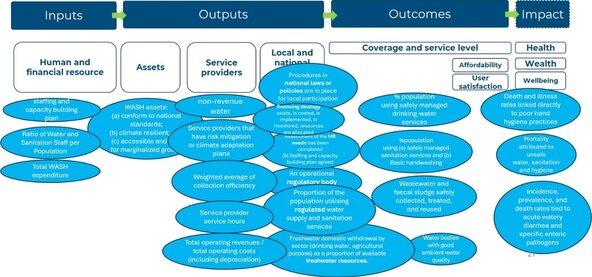
Figure showing harmonised indicators
Finally, digital platforms can play an important role in bringing together and visualising different data sets along the results chain. There have been efforts ongoing on this in various countries, with different levels of success.
So, all in all, data along the results chain can only be used to inform reflection, decision-making and accountability for accelerating WASH service provision only when all of these elements are in place.
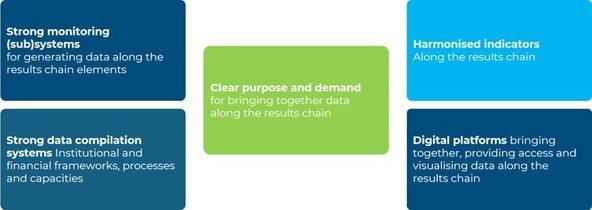
Figure showing that all elements need to be in place for decision-making and accountability
The way forward
Representing development partners, Leonard Tedd acknowledged that donor funding is shrinking. Going forward, the strategic use of donor support will be key, particularly in building political commitment. He pointed to cases where head-of-state commitment has made a real difference and noted that UK embassies have helped build that political traction, suggesting that this should continue.
Representing NGOs and civil society, Kate Harawa argued that going forward, NGOs need to move beyond collecting their own data and instead strengthen government systems. This includes helping develop collection tools and indicators, training government staff in data management, analysis, and visualisation, and mentoring rather than duplicating government roles. She stressed the importance of aligning NGO data with government monitoring frameworks, and supporting government capacity to verify and validate data, rather than treating collection as a one-off activity.
Representing data-focused organisations, Tom de Vries remarked we don't need better monitoring, but the ability to bring data together and translate it into faster action and accelerated progress. He reframed the core problem not as a lack of monitoring, but as a lack of "trusted action". He outlined three priorities: (1) co-creation of indicators with local stakeholders, including data producers at the lowest level, building in feedback loops so people see value in the data they contribute; (2) trust, driven by data quality/timeliness and by data being owned by the government body responsible for acting on it, not by external NGOs; and (3) government capacity building around data governance and interoperability, potentially through shared digital public infrastructure rather than one big centralised database.
All in all, it was agreed that going forward, harmonised global indicators can give structure to national data compilation, and that political commitment (national and global) is key.
NB: A recording of this session is available on YouTube: 12580 Improving data use on water for people