Article
How to put climate resilience at the heart of NGOs’ water, sanitation and hygiene interventions?
Climate resilience does not stop at the boundaries of individual projects.
A water supply project may be designed to withstand drought. Sanitation infrastructure may be built to cope with floods. But what happens when the wider systems around them—the organisations delivering services, the institutions managing them, and the policies governing them, are not prepared for climate change?
Climate resilience does not stop at the boundaries of individual projects. If we want communities to remain safe and services to keep working in a changing climate, we need to look beyond the projects we implement to the organisations and wider systems that provide those services.
Non-Governmental Organisations (NGOs) are active across the water, sanitation and hygiene (WASH) sector at every level, from community-led planning and infrastructure upgrades to national policy reform and global advocacy. Their work spans climate risk assessment, inclusive service delivery, innovative financing and system strengthening.
For example, Self Help Africa partnered with the University of Bristol to assess climate risks in Thyolo, Malawi. World Vision trained 648 WASH Committee members in Papua New Guinea, and SNV helped Nepali municipalities budget for climate-resilient water supply. SOIL Haiti is exploring carbon finance for sanitation. Sanitation and Water for All and their partners advocate for WASH in the Global Goal on Adaptation under the Paris Agreement.
With this diversity of approaches in mind, a 4-hour online course was designed by Riva, in collaboration with Aguaconsult, and hosted on the Systems Academy with support from the Osprey Foundation and the Shockwave Foundation. The rationale being that most NGOs are already contributing to climate resilience through community engagement, systems thinking and local ownership. The course builds on these strengths by bringing together the most relevant tools and practical actions. So, NGOs at any stage can focus on what they can actually change and make steady progress.
Water and sanitation is no longer just another sector hit by climate change. It is increasingly perceived as the foundation for broader climate resilience. Global efforts, including the UAE Global Climate Resilience Framework adopted at COP28, now call for resilient water and sanitation services to secure water supply and support adaptation goals. Global commitments like the Global Goal on Adaptation are important, but turning them into real solutions on the ground is difficult. NGOs are well placed to close that gap. Often working on the frontline, they can drive change and deliver climate-resilient solutions where they are needed most.
The course helps NGOs strengthen climate resilience at three connected levels. Each starts with a quick self-check, followed by practical actions.
Organisational readiness: Embedding climate resilience in an NGO’s own culture, including leadership commitment, strategy, staff skills, cross-team collaboration, funding and partnerships.
WASH programming: Applying a climate lens across the programme cycle, from risk-informed design and flexible implementation to monitoring, learning and responsible exit.
Systems-level change: Influencing the wider enabling environment, from global agendas and national policy to climate finance, institutional capacity, risk data and regulation.
Of these three levels, the first two, organisational readiness and WASH programming, fall within the Sphere of Impact, meaning what an NGO directly controls. The third, systems-level change, falls within the Sphere of Influence, where NGOs help shape the wider policy, financing and institutional environment.
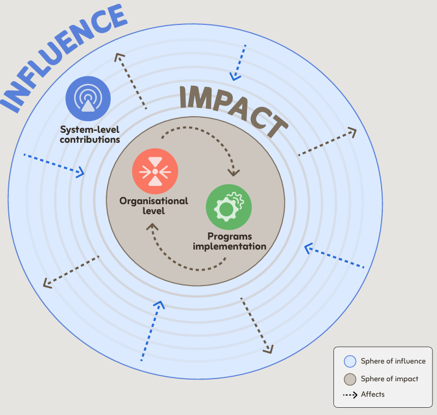
infographic showing spheres of influence
NGOs are far from uniform. Some work globally or regionally on advocacy, while others deliver services at the grassroots. Some work directly with communities, others through partners, and those partners are just as varied, from media and private companies to community-based organisations. This diversity is why the course is designed as a flexible framework rather than a fixed prescription. Whatever an NGO’s size, location or way of working, it can use the course to identify where it is best placed to strengthen the climate resilience of WASH systems.
Climate language is changing fast, and new terms and frameworks appear almost every year. Rather than chasing them, the course focuses on the core ideas behind climate-resilient WASH and explains them in plain terms. Once NGOs are comfortable with the fundamentals, they can explore newer concepts and terminology as they become relevant to their own work.
The course takes a whole-organisation approach, looking at how an NGO operates internally, the programmes it delivers, and its influence on partners and the wider sector. It works best as a team effort, not a solo task: climate resilience needs input from across the organisation, and working through it together leads to richer discussions and better decisions. Think of it as a guide rather than a manual. It helps you see what is already in place, spot the gaps, and decide what to prioritise next, with a practical framework you can adapt to your own context.
Start the course for free on the Systems Academy: Practical action towards climate-resilient water and sanitation systems | Systems Academy