Article
From guidance to action: Reflections on a new climate-resilient WASH course
From programme design and organisational planning to influencing wider systems change, non-governmental organisations (NGOs) are looking for practical ways to respond to growing climate risks.
During a recent course testing workshop in Ghana, one message came through clearly: organisations know climate resilience matters, but many are still working out what it means in practice. From programme design and organisational planning to influencing wider systems change, non-governmental organisations (NGOs) are looking for practical ways to respond to growing climate risks.
This challenge was at the heart of the development of the Practical Action Towards Climate-Resilient Water and Sanitation Systems course, hosted by the Systems Academy. Based on Strengthening Climate-Resilient WASH: A practical guide for NGOs to drive impact, collaboration, and scalability, the course aims to help organisations move from understanding climate risks to taking practical action.
Before its wider rollout, the course was beta-tested with WASH practitioners in Ghana. The experience offered valuable insights, not only into the course itself, but into how NGOs are thinking about climate resilience and their role in strengthening water and sanitation systems.
Climate resilience requires a different way of thinking
A key message running through both the practical guide and the course is that climate resilience is not simply an infrastructure issue.
Building more resilient water and sanitation systems requires organisations to think beyond individual projects and consider how climate risks are shaping institutions, service delivery, governance, financing and community wellbeing. It also requires organisations to strengthen their own capacity to anticipate, adapt and learn.
The course is structured around three interconnected areas:
- Organisational readiness and leadership
- Climate-responsive programming
- Influencing wider systems change
Together, these provide a practical framework for NGOs seeking to integrate climate resilience into the way they operate and the way they support others.
Listening to practitioners in Ghana
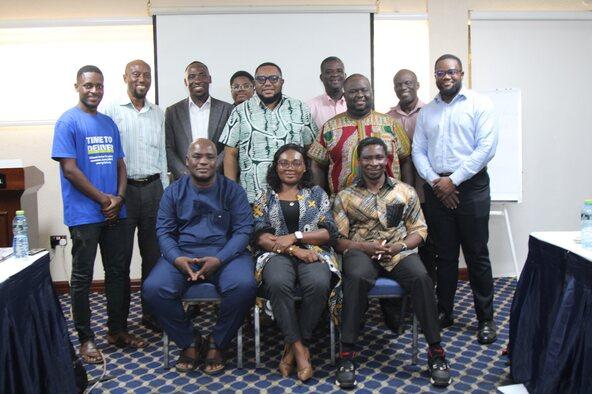
In July 2026, WASH practitioners from government, NGOs and sector support organisations came together in Accra to review and test the course before launch.
The overall response was positive. Participants saw value in having a practical resource that helps organisations translate climate resilience from a broad concept into concrete action.

Ato Kwamena Senayah of TREND Group shares his take on the climate-resilience course
As one participant, Ato Kwamena Senayah, Managing Consultant at TREND Group and Vice Chairman of the Coalition of NGOs in Water and Sanitation (CONIWAS) observed:
"The course provides a useful framework for organisations at different stages of their climate-resilience journey and encourages practical action rather than simply raising awareness."
Ato Kwamena Senayah, Managing Consultant at TREND Group
That distinction matters. Many organisations already recognise the threat that climate change poses to water and sanitation services. The challenge is often knowing where to start, how to prioritise action and how to embed resilience across their work.
Several participants noted that their organisations were already addressing climate-related risks in different ways but had not previously viewed these efforts through a climate-resilience lens. The course helped connect activities that often sit across different teams and programmes, enabling participants to see how organisational systems, programme decisions and influencing efforts can work together to strengthen resilience.
"A small local NGO and a large international organisation will approach climate resilience differently. The course needs to acknowledge these different capacities and starting points."
Ing. Oduro Donkor, WASH Specialist, ProNet South
This reflection reinforced an important lesson. Climate resilience is not a checklist. What good practice looks like will vary depending on an organisation's size, mandate, resources and operating context.

Emmanuel Dogbey of the Ministry of Local Government, Chieftaincy and Religious Affairs leading a group presentation.
Participants also emphasised the importance of grounding climate resilience in local realities as reflected by Emmanuel Dogbey of the Ministry of Local Government, Chieftaincy and Religious Affairs:
"Local examples help bring the concepts closer to our reality and make it easier to apply the lessons in our own work."
Emmanuel Dogbey of the Ministry of Local Government, Chieftaincy and Religious Affairs
Their feedback helped reinforce the importance of practical examples and context-specific learning, ensuring that the course remains relevant to organisations operating in diverse settings.
The unique role of NGOs
One of the strongest themes to emerge from the workshop was the importance of the NGO sector in driving climate resilience.
NGOs often sit at the intersection of communities, government institutions, service providers and development partners. This gives them a unique opportunity not only to implement programmes, but also to convene stakeholders, broker knowledge, test innovative approaches and influence decision-making.

Basilia Nanbigne, Executive Secretary of CONIWAS, pre-testing the online course.
As Basilia Nanbigne, Executive Secretary of CONIWAS noted:
"Climate resilience is not only about infrastructure. It is about communities, partnerships and ensuring that vulnerable groups are not left behind."
Basilia Nanbigne, Executive Secretary of CONIWAS
This perspective aligns closely with the course's emphasis on both impact and influence. While organisations can strengthen resilience through their own programmes, they can also help create enabling conditions for long-term change by supporting policy development, strengthening institutions and promoting learning across the sector.
The discussions in Ghana highlighted a broader reality: climate resilience cannot be delivered by NGOs alone. Sustainable progress depends on governments, utilities, regulators, communities, researchers, development partners and the private sector working together. Building resilience ultimately means strengthening the systems that connect them.
Turning guidance into action
One challenge across the development sector is that valuable guidance often remains underused. Reports are published, toolkits are launched and frameworks are endorsed, yet practical uptake can be limited.
The transition from a technical guidance document to an interactive online course was designed to address this challenge.
Rather than simply presenting information, the course encourages learners to reflect on their own organisations, identify strengths and gaps, and consider the next practical steps. Participants in Ghana particularly valued this action-oriented approach and the way it encourages organisations to assess their progress and identify opportunities for improvement.

Richard Ntibrey of WaterAid Ghana giving feedback on the CR-WASH course.
As Richard Ntibrey, Programme Manager, WASH and Climate Change at WaterAid Ghana reflected:
"The strength of this course is that it helps organisations think through what climate resilience means in practice and identify concrete actions they can take."
The feedback from Ghana also helped refine the course ahead of the launch, strengthening its content, accessibility and relevance for a wider audience.
Looking ahead
Climate change is reshaping the context in which water and sanitation services are planned, financed and delivered. For NGOs, responding effectively requires more than technical solutions. It requires stronger organisations, better partnerships and a commitment to continuous learning and adaptation.
The Practical Action Towards Climate-Resilient Water and Sanitation Systems course offers a practical starting point for that journey. It helps organisations understand where they are today, where they need to go, and the actions they can take to build more resilient water and sanitation systems.
Perhaps the most important lesson from the Ghana workshop was that climate resilience is not a destination. It is an ongoing process of learning, collaboration and adaptation. By creating space for reflection and practical action, the course provides NGOs with tools to play a stronger role in shaping resilient services and systems for the future.
Explore the course: Practical action towards climate-resilient water and sanitation systems