Article
From funding gaps to efficiency gains
Reflections from the Kathmandu WASH financing conference
Reflections on financing efficiency and systems from Kathmandu's WASH conference
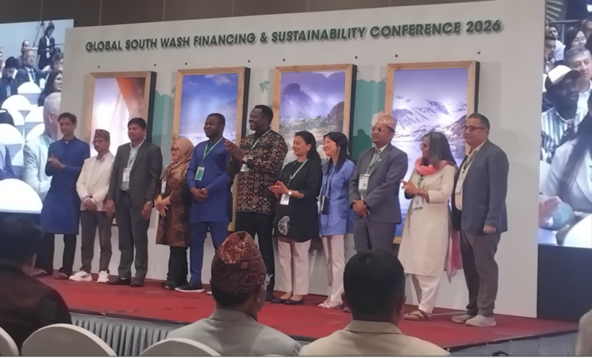
On April 1-3, 2026, I had the privilege of participating in the Global South WASH Financing and Sustainability Conference in Kathmandu, Nepal. This gathering brought together policymakers, practitioners, financial institutions, and development partners to confront one of the most pressing questions in the WASH sector: how do we finance sustainable, equitable, and climate-resilient water and sanitation services in a rapidly changing world?
The conference theme, “Financing the Future for Innovation, Climate Resiliency and Equity” could not have been more timely. Across the Global South, the challenge is no longer simply mobilising more money for WASH, but ensuring that financing systems are smarter, more efficient, and better aligned to long-term service sustainability. What emerged from Kathmandu was a powerful reframing of the WASH financing debate, one that has important implications for Uganda and other countries facing similar challenges.
Efficiency before new financing: a necessary shift in mindset
One of the strongest messages from the conference was that the real financing crisis in WASH is not always a lack of money, but inefficiency in how existing resources are used. Discussions revealed that up to 30% of WASH budgets in many contexts remain unspent or underutilised due to procurement bottlenecks, weak financial absorption systems, delayed disbursements, and fragmented planning processes. This insight challenges a common assumption in development discourse that financing gaps are primarily caused by insufficient capital. In reality, many governments and institutions are unable to fully utilise the funds already allocated.
For Uganda, this presents both a challenge and an opportunity. Strengthening budget execution, procurement efficiency, and expenditure tracking could unlock significant gains without necessarily increasing allocations. Efficiency is not merely a technical issue, it is the foundation upon which stronger financing credibility is built.
Public leadership is the anchor for sustainable WASH financing
Another clear takeaway from Kathmandu was that sustainable WASH financing cannot be outsourced. Public sector leadership remains indispensable. Governments must lead in designing financing strategies, integrating WASH into national development planning, coordinating across ministries, and reforming public financial management systems. The conference underscored that successful financing reforms depend on strong state stewardship, not fragmented project-driven approaches.
This resonates strongly with Uganda’s experience. IRC Uganda’s contribution to the conference, through the presentation on harmonised national WASH indicator monitoring, demonstrated how stronger government-led data systems can improve accountability and inform better financing decisions. When governments own the systems, financing becomes more predictable, strategic, and scalable.
The missing link: bankable WASH projects
A recurring theme throughout the conference was that financing shortages are often pipeline shortages. Many countries are not failing because investors are absent; they are struggling because they lack well-prepared, investment-ready WASH projects. Blended finance, concessional loans, and climate funds are increasingly available, but only where technically sound, financially viable, and risk-assessed projects exist. Too often, district and municipal systems lack the capacity to prepare such projects.
For Uganda, this means investing more deliberately in project preparation capacity at both national and subnational levels. District WASH plans need stronger lifecycle costing, financial modelling, and investment packaging if they are to attract external finance.
Climate resilience must be built into financing models
Climate change was not treated in Kathmandu as a separate thematic concern, it was recognised as central to the future economics of WASH systems. Rising temperatures, floods, droughts, and extreme weather are already increasing infrastructure costs, operational energy demands, and maintenance burdens. Yet climate finance for WASH remains slow, fragmented, and largely project-based rather than system-based.
This is particularly relevant for Uganda, where climate vulnerability is increasingly affecting water availability, infrastructure durability, and service reliability. Climate resilience can no longer be an afterthought or a donor-driven add-on; it must become a core design principle in WASH financing models from the outset.
Informal WASH enterprises: an untapped growth frontier
One of the most practical and transformative insights from the conference concerned the role of informal sanitation actors. Small-scale pit emptiers, local sanitation entrepreneurs, and informal service providers remain central to service delivery in many low-income settings, yet they are often excluded from formal financing systems.
The conference highlighted that transitioning these actors into formal, bankable enterprises through cooperatives, financial readiness support, and business development services can unlock scalable private sector participation.
In Uganda, where sanitation service delivery still largely depends on informal operators, this presents a compelling pathway for inclusive market development. Rather than replacing informal actors, the goal should be to strengthen and formalise them.
Data is becoming the currency for WASH financing reform
Perhaps the most strategic lesson from Kathmandu is that reliable data is now central to financing reform. Investors, governments, and development partners increasingly require credible evidence to justify investments, assess risks, and track returns. Strong monitoring systems are no longer simply accountability tools, they are financing instruments.
Uganda’s growing experience with harmonised WASH indicators offers an important model here. By improving service monitoring and sector-wide data consistency, the country is laying the foundation for stronger financing decisions and more transparent resource allocation.
Moving from global dialogue to national action
The Kathmandu conference reaffirmed that the future of WASH financing lies not in chasing funding alone, but in building stronger systems, systems that spend better, plan better, measure better, and adapt better.
For Uganda, the path forward is to:
- Improve efficiency before expanding financing envelopes
- Strengthen public financial management in WASH
- Build pipelines for bankable projects
- Integrate climate resilience into all financing models
- Support informal enterprises to become investment-ready
- Continue investing in robust monitoring and evidence systems
The challenge now is translating these global insights into practical reforms that strengthen national systems and deliver lasting services for communities.
Kathmandu was not simply a conference about money. It was a reminder that sustainable WASH financing is ultimately about governance, systems, and the choices we make in how we steward scarce resources for long-term public good.