Article
Credit where credit is due: building creditworthy rural utilities
Reflections from strengthening creditworthiness of water utilities in Rwanda under Isoko y'Ubuzima.
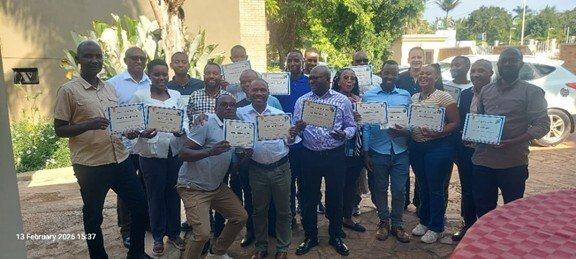
Photo: Always a joyful moment when participants are receiving their certificates
Within Rwanda's rural water model, operators play a critical role—but they do so within a broader institutional framework. The infrastructure itself—the pipes, reservoirs, and treatment systems—remains publicly owned by WASAC. Operators are responsible for operation and maintenance, while larger repairs and capital investments remain under WASAC's responsibility. Their contracts typically run for five years. This arrangement creates a clear structure for service delivery, but it also shapes what is possible when it comes to accessing finance.
One of the themes we explored during the training was creditworthiness: what it means for a water utility to be trusted as a reliable and financially sound organisation. At first glance, this discussion naturally turns to loans and commercial finance. But for many rural operators, obtaining a commercial loan is not an immediate or even realistic objective. Contract duration, asset ownership, and scale all create structural barriers. Banks look for long-term revenue certainty and assets that can serve as collateral—conditions that are not always present in rural water service delivery. Yet, this does not make creditworthiness irrelevant. On the contrary, it makes it essential.
Creditworthiness is not simply about accessing a loan. It is about running a utility in a professional, transparent, and sustainable way. It is about knowing your costs, managing your revenues, maintaining your infrastructure, and planning ahead. It is about building trust—with customers, regulators, asset owners, and ultimately, financial institutions.
This is why the first step towards creditworthiness is not approaching a bank. It is something much more fundamental: getting your house in order.
The six steps explored during the training—from strengthening internal management and planning investments, to engaging stakeholders and lenders—highlighted that creditworthiness is a gradual process of institutional strengthening. It requires coordination between operational teams and planning teams, clarity in contracts and responsibilities, and a long-term view of service delivery.
One of the most important insights from the training was a shift in perspective. Obtaining a loan is not the primary goal. Becoming creditworthy is valuable in itself. A creditworthy utility has control over its operations. It understands its costs. It plans its investments. It builds trust with stakeholders. These qualities improve service delivery regardless of whether external finance is accessed.
Utilities can assess their progress along this journey using tools such as WaterCred, which allow utilities to conduct structured self-assessments, identify gaps, and prioritise improvements. This helps utilities strengthen their foundations step by step.
This aligns closely with IRC's long-term work under Isoko y'Ubuzima and across Africa: supporting utilities not just to function, but to mature into professional service providers capable of sustaining and expanding services over time.
These reflections connect directly to the broader continental agenda on water sector professionalisation. Through the Africa Water and Sanitation Systems Leadership symposium, sector leaders across Africa are highlighting professionalisation and creditworthiness as key priorities. AMCOW and its partners increasingly recognise that unlocking both public and commercial finance depends on utilities that are well managed, transparent, and accountable.
The experiences from Rwanda—and similar efforts in countries such as Uganda—show that utilities are already on this path. Operators are strengthening their financial systems, improving operational performance, and building the institutional maturity needed for long-term sustainability.

Creditworthiness, in this sense, is not defined by obtaining a loan. It is defined by becoming a utility that is trusted, capable, and sustainable.
It begins with getting your house in order. And from there, everything else becomes possible.
----------------------
This training was part of the Isoko y’Ubuzima programme, through which IRC works with national and district partners in Rwanda to strengthen professional rural water service delivery. IRC's long-term role in the sector focuses on strengthening the systems that underpin sustainable services: supporting utilities, regulators, and government institutions to move beyond short-term project delivery towards reliable, professionally managed water services that last. Participants and interested colleagues are encouraged to follow the World Bank course on creditworthiness to learn more. This blog was reviewed by Afou Chantal Bengaly.