Article
From commitments to change: Africa’s water and sanitation leaders call for a new era of systems leadership
Africa’s water and sanitation sector has reached a defining moment.
For decades, the continent has invested in infrastructure, developed policies, mobilised development assistance and convened countless dialogues on the urgent need to expand access to safe water and sanitation. Yet, as leaders, practitioners, financiers, governments and development partners gathered in Kigali, Rwanda, for the Africa Water and Sanitation Systems Leadership Symposium, one message came through with unmistakable clarity: Africa does not lack ambition. The greater challenge is turning ambition into implementation, investment and sustainable services.
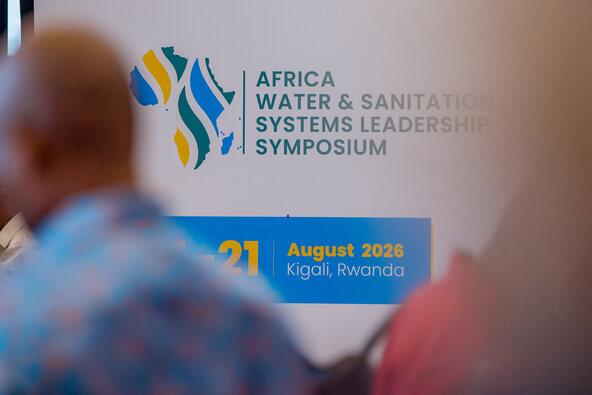
Held from 17–21 August 2026, the symposium brought together African and global actors to examine what it will take to move the water and sanitation agenda from policy commitments to functioning systems that deliver reliable, affordable, safe and resilient services to people and communities.
The discussions placed systems leadership at the centre of Africa’s water future, linking political leadership, governance, financing, institutional capacity, regulation, professionalisation, data, innovation and accountability.
Beyond infrastructure: redefining transformation
Opening discussions challenged a long-standing assumption that transformation in the water sector is primarily about constructing more infrastructure. The message from the symposium was clear: building infrastructure is necessary, but it is not transformation in itself. Transformation means creating systems that continue to perform, attract investment, recover appropriate costs, protect vulnerable populations and remain accountable to citizens.
The Minister of Infrastructure of the Republic of Rwanda emphasised that Africa’s challenge is no longer simply to build more infrastructure, but to establish reliable, affordable, safe, resilient and sustainable water and sanitation systems capable of serving growing populations and economies.
This requires a fundamental shift from projects to systems, from infrastructure delivery to sustainable services, and from dependence on external financing towards stronger domestic resource mobilisation and sector leadership. It also requires clearer ownership and accountability. As one of the central discussions in Kigali demonstrated, water and sanitation cannot continue to be treated merely as social-service expenditures. They must increasingly be recognised as productive economic assets that underpin health, food security, energy, employment, productivity, climate resilience and broader economic transformation.
The credibility gap: why finance follows confidence
One of the most important conversations at the symposium centred on the persistent credibility gap between the water sector and potential investors. Africa has significant investment needs, but the challenge is not simply finding money. Investors also need confidence that the institutional, regulatory and financial environment will allow investments to perform over time. The discussions highlighted predictable tariffs, appropriate subsidy arrangements, accountable institutions, effective regulation, credible policies and stronger project preparation as critical components of investment confidence.
A particularly important observation was that there is considerable financing available for infrastructure construction, while less attention is often given to the financing gaps that enable utilities and service providers to remain viable, maintain assets, improve collection efficiency and provide affordable services to low-income communities.
This points to an important lesson: mobilising capital for water and sanitation requires more than announcing investment targets. It requires fixing the systems that make investment possible. The symposium therefore called for stronger pipelines of bankable and investable projects, improved institutional capacity and reforms capable of attracting finance at scale.
Leadership must move first
When participants were asked which element, leadership, regulation, professionalism or strategic public finance, should move fastest, a strong theme emerged around leadership. Leadership was viewed as foundational because it establishes the vision, priorities, incentives and accountability structures within which the other reforms operate. At the same time, the discussions highlighted an important qualification: leadership without financing can remain little more than an announcement; regulation without resources can become a set of unenforced rules; and professionalisation without sustainable business models may falter when systems require long-term maintenance.
In other words, these elements cannot operate in isolation. Systems leadership means connecting political commitment, finance, regulation, institutional performance and professional capacity around a shared outcome. That is perhaps one of the most important lessons from Kigali.
Sanitation must become an investment priority
The symposium also brought sanitation firmly into the investment and economic discussion.
Participants examined practical examples demonstrating that sanitation transformation requires attention to the entire sanitation value chain, from containment and collection to transportation, treatment, reuse and final disposal. The discussions highlighted that behaviour change, data, professionalisation of informal actors, climate resilience, financing, markets for recovered resources and procurement reform all matter. One of the key sessions concluded that lasting sanitation outcomes cannot be achieved through infrastructure alone. Behaviour change is critical, data can expose hidden service gaps, and informal sanitation workers and operators should be professionalised rather than bypassed.
The discussions also highlighted the potential of circular economy approaches. Examples presented during the symposium demonstrated how waste can become a resource, creating employment and economic opportunities while improving environmental outcomes. One case presented showed how treated faecal sludge could be converted into compost and contribute to green employment, illustrating the potential of moving from a conventional “waste problem” narrative towards a waste-to-value and waste-to-jobs approach. However, participants also acknowledged that circular economy models require viable markets, appropriate standards, regulation and investment if they are to move beyond isolated pilots.
Uganda’s experience: coordination as a pathway to systems change
Uganda’s experience featured among the examples demonstrating how systems can respond to fragmentation. A key takeaway from the sanitation discussions was the importance of multi-actor coordination mechanisms in overcoming institutional silos and duplication. Cases from Uganda and other countries demonstrated how coordination bodies can bring together actors who traditionally operate separately and create a more coherent approach to sector planning and implementation. This is particularly relevant to Uganda, where water and sanitation outcomes depend on the interaction of national and local government institutions, utilities, private operators, communities, development partners, researchers and civil society.
For Riva Uganda, this reinforces an important principle: systems change is rarely achieved by one organisation working alone. It requires relationships, coordination, shared accountability and collective action across the system.
From donor cycles to sustainable financing
Another recurring theme was the need to move beyond approaches that leave essential water and sanitation services overly dependent on short-term project and donor cycles. The symposium discussions stressed the importance of sustainable financing models that can support services beyond the lifespan of individual projects. This includes stronger domestic resource mobilisation, appropriate tariffs and subsidies, blended finance, credit guarantees, investment-readiness mechanisms and greater participation by responsible private capital.
Participants noted that private investment will not automatically flow simply because the sector has large financing needs. Governments and sector institutions must create the conditions that make investment credible and sustainable.
The example of Senegal illustrated the scale of ambition possible when water security is connected directly to economic transformation, climate resilience and social development. Senegal reported significant planned mobilisation for water and sanitation between 2026 and 2029, alongside governance reforms, investment-readiness measures and efforts to create a more predictable environment for private capital.
The lesson for Africa is compelling: The question should no longer be whether water deserves investment, but how African countries can create the conditions for sustained investment to deliver measurable results.
Climate change makes systems leadership even more urgent
Climate change was another important dimension of the Kigali conversations. Water systems are increasingly exposed to floods, droughts, heatwaves and changing patterns of water availability. Yet, as the symposium discussions noted, climate resilience and sanitation planning are still too often treated separately. This disconnect creates significant risks. Infrastructure can be damaged or destroyed by climate-related events, while climate financing may fail to adequately account for sanitation and other essential service infrastructure.
Building resilient systems therefore requires integrating climate risk into planning, investment decisions, infrastructure design, service delivery and institutional preparedness.
For Africa, water security and climate resilience are increasingly inseparable.
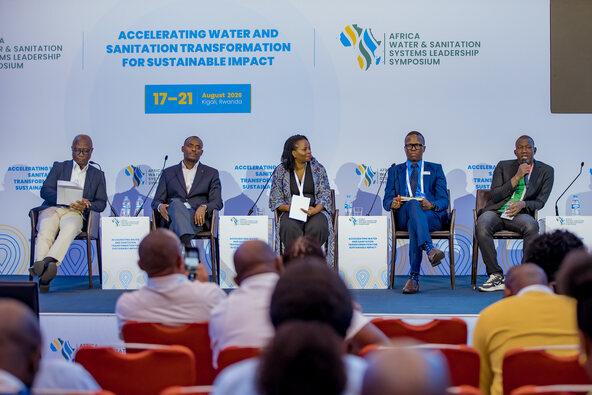
Session on professionalising Africa's sanitation sector at the Kigali symposium
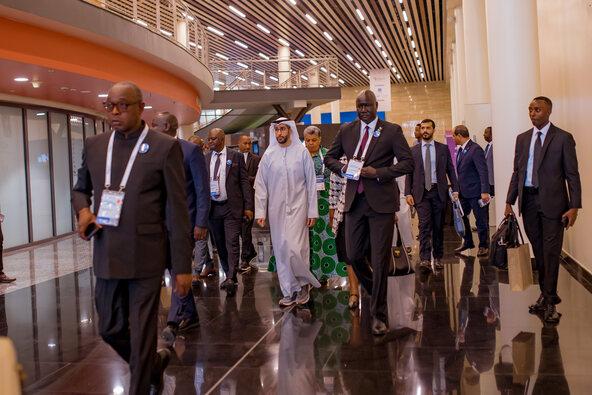
Country delegates at the Africa Water & Sanitation Systems Leadership symposium
From Kigali to Abu Dhabi: carrying Africa’s voice forward
The Kigali Symposium was also positioned within the broader journey towards the 2026 United Nations Water Conference. The UAE and Senegal highlighted the importance of using the global conference to translate Africa’s growing political momentum around water into investment, partnerships and concrete implementation. The symposium discussions identified the need for stronger investment pipelines, greater institutional capacity and reforms capable of attracting finance at scale. The ambition is therefore not simply to arrive at the global water conference with another set of declarations. Africa must arrive with projects, investment opportunities, reforms, partnerships and commitments that can be implemented. As the symposium discussions made clear, the real measure of success will not be the number of speeches delivered or commitments announced, but what happens after the conference.
A new role for locally led systems transformation
An important institutional development announced during the symposium was the evolution of IRC into a new network and federation of independently led member organisations, with stronger local leadership and global connectivity. The announcement emphasised a shift away from the traditional model of aid in which the North funds and directs delivery in the South, towards approaches that strengthen locally led governance, institutions and systems.
For organisations such as Riva Uganda, this evolution speaks directly to the changing nature of development cooperation. Africa’s water and sanitation challenges require African leadership, African institutions, African knowledge and African solutions supported by global partnerships where those partnerships add value.
The Kigali message: implementation is the new frontier
Perhaps the most powerful message emerging from the symposium can be captured in one word: Implementation.
Africa has policies.
Africa has strategies.
Africa has investment needs.
Africa has technical expertise.
Africa has innovators.
Africa has development partners.
And Africa has political commitments.
The task now is to connect these assets into systems that deliver results.
The symposium challenged participants to move beyond repeatedly diagnosing the same problems and instead make the difficult decisions required to change them, including decisions around financing, tariffs, regulation, institutional accountability, investment readiness, professionalisation and coordination.
It also reminded participants that accountability does not belong only to governments and development partners. Citizens, professionals, private operators, civil society and other sector actors all have a role in demanding better performance and contributing to better systems.
What does Kigali mean for Riva Uganda?
For Riva Uganda, the symposium reinforces the importance of working beyond individual projects towards systems strengthening and sustainable transformation. It provides renewed impetus to support approaches that:
- strengthen locally led water and sanitation governance;
- promote effective coordination among sector actors;
- connect policy and strategy with implementation;
- strengthen investment readiness and sustainable financing;
- support professional and accountable service delivery;
- promote evidence, data and learning for decision-making;
- integrate climate resilience into water and sanitation planning;
- strengthen the role of communities and citizens in accountability; and
- foster partnerships that can take successful approaches to scale.
The symposium also creates an important opportunity for Riva Uganda to continue contributing Ugandan experiences to the continental water and sanitation conversation while learning from innovations and reforms taking place across Africa.
From Kigali conversations to action
As delegates departed Kigali, the central question was no longer what is the problem? The sector knows many of the problems. The more important question is: What will we do differently now?
The Africa Water and Sanitation Systems Leadership Symposium provided a platform for governments, financiers, development partners, private-sector actors, researchers, civil society and practitioners to confront that question together. The answer will ultimately be measured not in conference halls, policy documents or investment announcements, but in whether people experience safe, reliable, affordable, resilient and sustainable water and sanitation services. That is the real test of systems leadership. And that is where the work begins after Kigali.
From commitments to investment.
From investment to implementation.
From implementation to sustainable services.
And from sustainable services to healthier, more resilient and prosperous communities.
For Africa’s water and sanitation sector, the next chapter is not about talking more. It is about making systems work.